






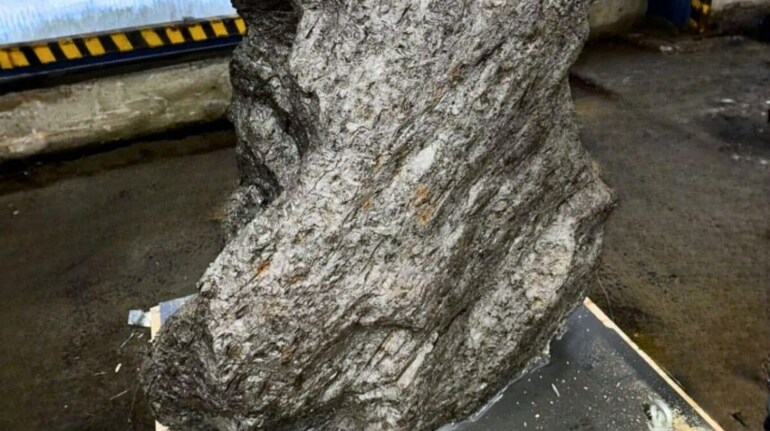

Russian customs officials have intercepted a misdeclared shipment at Saint Petersburg’s port, uncovering a massive meteorite fragment bound for the United Kingdom, according to authorities. The container, stopped during routine inspection, was officially listed as carrying decorative landscaping material. Cargo scans revealed unusual density within the crate, prompting further examination. Officials later opened the container and discovered a large, dark metallic mass, unlike items typically exported through commercial channels, raising immediate scientific and legal concerns.
Russian authorities later confirmed the object was a 2.8-ton fragment of the Aletai meteorite, one of the largest known iron meteorites ever documented. The Federal Customs Service said the meteorite had been falsely declared as garden art, violating laws governing the export of strategically significant natural resources.
Officials estimated the fragment’s market value at more than 323 million rubles, approximately 4.2 million dollars, based on a statement released on 5 February. Footage published by authorities showed customs officers uncovering the dense metallic body, whose rough grey surface did not match shipping descriptions. The Moscow Times reported the discovery followed a standard cargo inspection.
Investigators have not identified any individual or organisation linked to the shipment. Authorities also remain unclear about how the meteorite entered Russian territory or whether it was previously held in a scientific or private collection. No export permits were found accompanying the cargo, officials said.
Aletai Meteorite Highlights Scientific and Legal Importance
The Aletai meteorite was first recorded in 1898 in China’s Xinjiang region and is classified as a Group IAB iron meteorite. Scientists say such meteorites consist mainly of iron and nickel alloys formed within early planetary bodies over 4.5 billion years ago.
These materials provide valuable insight into the structure and thermal evolution of the early solar system. Iron meteorites are known for surviving atmospheric entry, making large intact fragments rare yet highly prized. Researchers warn that undocumented private trade risks permanent scientific loss. Under Russian law, certain meteorites are classified as protected natural objects and cannot be exported without state approval.
Smuggling Concerns Grow as Meteorite Demand Increases
Authorities say the case reflects broader vulnerabilities in cross-border controls over geological materials. Misdeclaration remains a common tactic used to move high-value items, including fossils and rare minerals. While countries such as the United Kingdom allow private meteorite ownership, Russia treats many specimens as national property. Demand for meteorites has risen steadily in recent years, with iron fragments commanding high prices in private markets.
As of 6 February 2026, the seized meteorite remains in government custody. Forensic testing is underway to confirm its classification and possible links to known Aletai fragments. The criminal investigation continues, with no arrests announced.
Discover the latest Business News, Sensex, and Nifty updates. Obtain Personal Finance insights, tax queries, and expert opinions on Moneycontrol or download the Moneycontrol App to stay updated!
Find the best of Al News in one place, specially curated for you every weekend.
Stay on top of the latest tech trends and biggest startup news.





