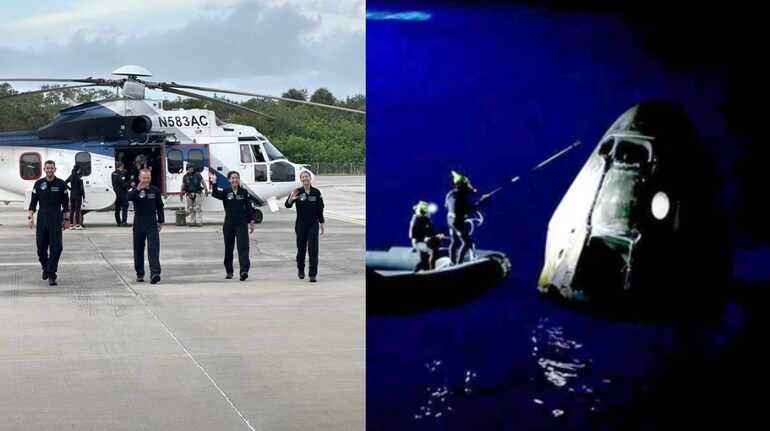
In a remarkable achievement for space exploration, SpaceX’s Polaris Dawn crew safely returned to Earth on Sunday at 3:37 am ET. Their five-day mission included the world's first commercial spacewalk, pushing the boundaries of private space travel. This historic journey also marked the farthest human venture into space since NASA’s Apollo programme ended in 1972.
The Crew Dragon capsule carried four astronauts: mission commander and billionaire Jared Isaacman, former US Air Force pilot Scott “Kidd” Poteet, and SpaceX engineers Anna Menon and Sarah Gillis.
The spacecraft splashed down near Dry Tortugas, Florida, on September 15, marking the capsule’s third successful space mission. SpaceX selected Dry Tortugas as the landing site to improve the odds of favourable weather conditions. An X post from SpaceX explained: “Dry Tortugas adds greater geographic diversity for Dragon’s return.”
Dragon's hatch is open and the Polaris Dawn crew is getting ready to exit the spacecraft pic.twitter.com/KItVBSwJffSpaceX (@SpaceX) September 15, 2024
As the capsule re-entered Earth's atmosphere, it performed a "de-orbit burn" to begin its descent. Travelling at 17,000 miles per hour, the spacecraft faced scorching temperatures up to 3,500 degrees Fahrenheit (1,900 degrees Celsius). Thanks to Crew Dragon’s heat shield, the astronauts remained comfortable during re-entry.
After deploying parachutes, the capsule safely splashed into the ocean. SpaceX's rescue team, using a specialised vessel called “Dragon’s Nest,” retrieved the capsule from the water 30 minutes later. Elon Musk shared a photo of the crew in spacesuits, smiling after their historic return. “Polaris crew is home safe & sound,” Musk tweeted.
Polaris crew is home safe & sound! https://t.co/2wch1wlBoXpic.twitter.com/BYfz3pq3x5 Elon Musk (@elonmusk) September 15, 2024
The mission, launched on September 10, achieved several milestones, including reaching an altitude of 870 miles—making it the highest altitude by a crewed spacecraft since 1972. The journey also featured a historic spacewalk. Isaacman and Gillis tested SpaceX’s new spacesuits during a two-hour extravehicular activity (EVA), providing valuable data for future commercial spacewalks.
During their time in orbit, the crew conducted 40 scientific experiments in microgravity. These experiments focused on human health and safety in space, furthering the understanding of how humans can survive and thrive in space environments.
NASA hailed the mission as a "giant leap forward" for the commercial space industry. The entire Polaris Dawn journey was livestreamed by SpaceX, allowing viewers to witness history in the making.
The mission was not only a technological success but also a testament to the power of private space exploration, as civilians reached new frontiers in space.
Discover the latest Business News, Sensex, and Nifty updates. Obtain Personal Finance insights, tax queries, and expert opinions on Moneycontrol or download the Moneycontrol App to stay updated!
Find the best of Al News in one place, specially curated for you every weekend.
Stay on top of the latest tech trends and biggest startup news.