






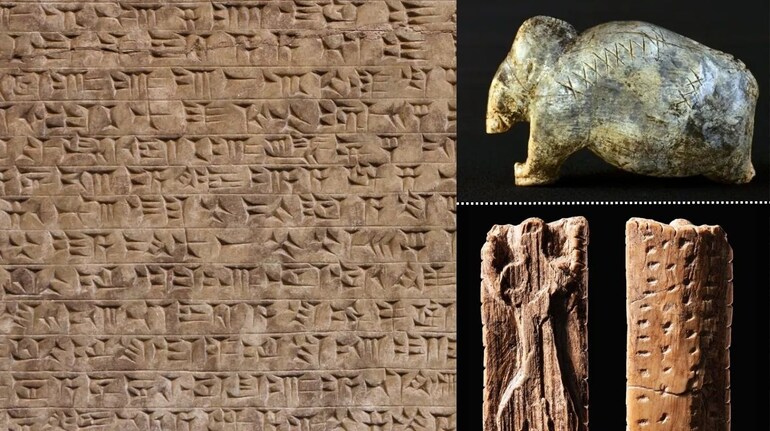

A new analysis of 40,000-year-old engravings discovered in southwestern Germany. This suggests that Ice Age hunter-gatherers were using structured symbols far earlier than previously believed. The findings are now raising many provocative questions. Scientists solved the mystery behind the writing that took place tens of thousands of years before humans.
What Did Scientists Find?
Researchers found more than 260 Ice Age artefacts in Germany. These artifacts beared engraved markings including pendants, tools and figurines carved from mammoth ivory. They are documented over 3,000 individual symbols.
Symbols such as dots, straight lines, cross-hatching, angled strokes and geometric sequences. At first glance, the markings seemed decorative. But after analysis, scientists observed consistent repetition and structural patterns.
BREAKING🚨: The world’s oldest form of writing has been found in a cave in Germany, dating 38,000 years pic.twitter.com/k0SRMWiK7w— All day Astronomy (@forallcurious) February 24, 2026
Where Is This Ancient Writing From?
The artefacts were excavated from caves in the Swabian Jura. This a region in southwestern Germany which is famous for some of Europe’s oldest known art. Many of the objects come from sites such as Hohle Fels Cave.
Here early modern humans used to live during the Upper Palaeolithic period, roughly 40,000 years ago. This era marked the arrival of Homo sapiens in Europe.
Who Is Behind This Study?
A rock-solid study was published in the journal Proceedings Of The National Academy of Sciences. “It makes sense to look at sequences, because information is not only encoded in the number of different signs you have, but… in how you combine the signs,” said Christian Bentz. He is a study collaborator at Saarland University in Saarbrucken.
What Did Scientists Observed on these Writing?
The key observation was that the symbols demonstrate structural patterns. Certain shapes recur consistently. Some marks appear arranged in rows or repeated sequences, hinting at counting systems or notational structures.
The density and arrangement of these symbols show similarities to proto writing systems such as early cuneiform. While they do not represent language directly, they may encode information visually.
Are These Writings Some Warning?
There is no evidence that the engravings were warnings in the modern sense. However, they may have served practical or symbolic purposes. If these 40,000-year-old engravings truly represent structured symbolic notation, the implications are profound.
For decades, scholars have placed the birth of writing within early agricultural civilisations around 5,000 years ago. This discovery does not simply add a footnote to the history of writing. It pushes the timeline of symbolic complexity dramatically backward.
Discover the latest Business News, Sensex, and Nifty updates. Obtain Personal Finance insights, tax queries, and expert opinions on Moneycontrol or download the Moneycontrol App to stay updated!
Find the best of Al News in one place, specially curated for you every weekend.
Stay on top of the latest tech trends and biggest startup news.





