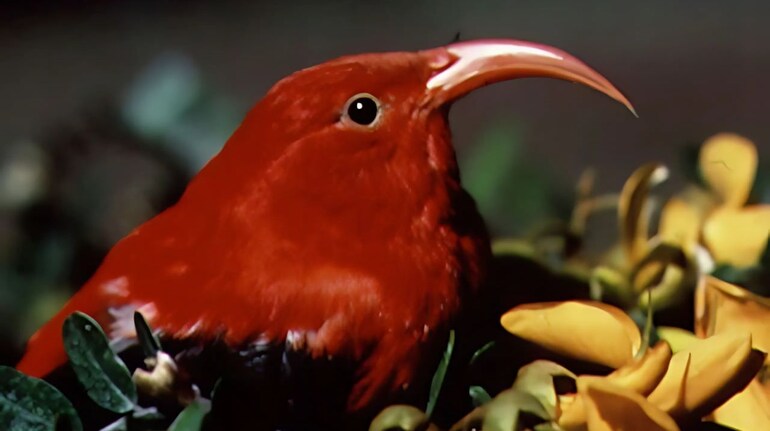
In the lush rainforests of Kaua‘i, the once-vibrant melodies of native honeycreepers are fading. Their colourful feathers and sweet chirps are slowly vanishing from the trees. A new scientific study brings a flicker of hope, suggesting their story might not end—at least, not yet.
A Genetic Glimpse into Survival
A team of scientists from San Diego Zoo Wildlife Alliance, Smithsonian’s National Zoo and Conservation Biology Institute, and other partners have uncovered new insights into Hawaii’s iconic honeycreepers. Their research focuses on three species—the extinct po‘ouli and the critically endangered ‘akikiki and ‘akeke‘e.
Published in Current Biology, the study reveals that even these tiny, dwindling birds still hold strong genetic diversity. That could be key to helping them adapt to threats—if urgent action is taken.
“In a race against time to save the remaining honeycreepers, necessary insights about their survival are found in their genetic makeup,” said lead author Dr Christopher Kyriazis of San Diego Zoo Wildlife Alliance. “Our findings offer new understanding as recovery efforts continue in the wild and in human care.”
Avian Malaria’s Climbing Reach
The sharp decline in honeycreeper numbers is largely due to avian malaria. The disease is spread by non-native mosquitoes, which have reached higher altitudes as temperatures rise. With no natural immunity, these birds are being hit hard.
The damage has been most severe on Kaua‘i, an island without high-elevation refuges. Populations of both the ‘akikiki and ‘akeke‘e have crashed by over 99% in just twenty years. Fewer than 100 ‘akeke‘e are believed to remain, and the ‘akikiki now survives only in captivity.
To fight the disease, conservationists are releasing sterilised male mosquitoes to slow reproduction. These efforts are underway and could be the last hope for saving what’s left.
A Future Stored in Frozen Cells
Today, only around 40 ‘akikiki live in conservation breeding centres on Maui and the Big Island. Genetic analysis shows inbreeding is already causing trouble. Some birds are the result of close relatives mating, and they produce fewer chicks that are less likely to survive.
These findings are being used to guide future breeding choices, helping teams carefully match mates to preserve genetic strength.
The research also revisits the story of the po‘ouli—a species that vanished in the early 2000s. Before it was lost forever, scientists cryopreserved a cell line from the last individual. Stored in the San Diego Zoo’s Frozen Zoo®, this sample has now been sequenced, offering lessons that might help other endangered birds.
“We will never hear the po‘ouli honeycreeper’s song again, but we can learn from its genetic code,” said Dr Oliver Ryder, director of conservation genetics at the Alliance.
The message from the study is clear: time is running out, but all is not lost. With science, strategy, and a little bit of luck, Hawaii’s honeycreepers may yet sing again.
Discover the latest Business News, Sensex, and Nifty updates. Obtain Personal Finance insights, tax queries, and expert opinions on Moneycontrol or download the Moneycontrol App to stay updated!
Find the best of Al News in one place, specially curated for you every weekend.
Stay on top of the latest tech trends and biggest startup news.