






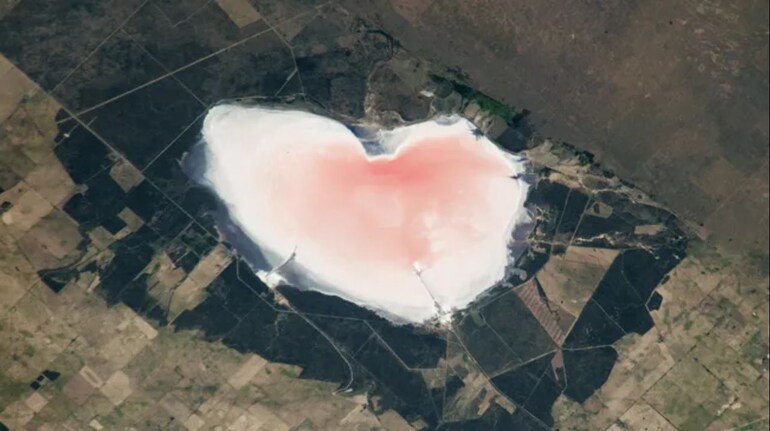

A satellite image has revealed a vast pink, heart-shaped salt lake in Argentina, highlighting how shifting water, salt and microbes shape landscapes visible from orbit.
The lake, known as Salinas Las Barrancas, lies in Buenos Aires province. It stretches nearly 6.2 miles at widest. The basin sits below sea level. Rainwater briefly fills the shallow depression. Strong sun then drives rapid evaporation. Salt concentrations rise as water retreats.
From space, the outline resembles a heart. Its colour shifts between pale and bright pink. Scientists say this reflects living microbes. The lake’s appearance changes with rainfall cycles. It is not a fixed landmark.
Microbes Give Pink Salt Lake Colour
Research led by Maria A. Sierra at Weill Cornell Medicine examined salt loving organisms. Her team mapped microbes thriving in brine. These organisms tolerate intense sunlight and salinity. As salt increases, pigments become stronger.
One microbe, Dunaliella salina, produces orange red carotenoids. Other salt tolerant species add further pigments. Together they deepen the pink shade. Heavy rain can dilute the brine quickly. The heart shape may remain visible. However colour often fades after flooding.
Sierra’s group also studied Lake Hillier in Australia. Using metagenomics, they analysed community DNA. Sierra wrote their work was first. It deciphered the source of Hillier’s colour. Results narrowed pigment production to key steps.
Salt Harvesting and Satellite Monitoring
Salinas Las Barrancas lies 33 miles west. It stands near the port of Bahia Blanca. Local crews extract up to 330,000 tons yearly. Mining occurs twice between rainy periods. Small depth shifts redraw shorelines quickly.
An astronaut aboard the International Space Station photographed the pink heart. NASA released the original frames publicly. Analysts study wavelengths reflecting from brine. These patterns reveal mineral and pigment changes.
Elsewhere, ice shaped another striking outline. In January 2025, Lake St. Clair froze fully. It links Lake Huron and Lake Erie. Wind cooled waters before ice sealed surface.
Satellite maps from NOAA Great Lakes Environmental Research Laboratory tracked coverage daily. Records date back to 1973 winters. These comparisons aid shipping and fishing. They also show shifting seasonal patterns.
Flamingos and insects rely on brine cycles. Pigments can move through food webs. Small weather changes can erase heart shapes. Yet images still carry valuable environmental data. Future monitoring may guide miners and ecologists alike.
Discover the latest Business News, Sensex, and Nifty updates. Obtain Personal Finance insights, tax queries, and expert opinions on Moneycontrol or download the Moneycontrol App to stay updated!
Find the best of Al News in one place, specially curated for you every weekend.
Stay on top of the latest tech trends and biggest startup news.





