








James Webb Space Telescope has captured a breathtaking cosmic farewell. It shows a dying star releasing its outer layers into space. This spectacular scene appears inside the famous "Helix Nebula". Located about 650 light-years away in the constellation Aquarius. Scientists say this image reveals how stars end their lives. It also shows how cosmic material is recycled across the universe.
What Is the Helix Nebula?
The Helix Nebula is a planetary nebula formed by dying stars. It forms when stars similar to the Sun lose outer layers. At its centre lies a white dwarf, the stellar core. This remnant releases intense radiation, energising surrounding gas clouds. Over time, expanding gas creates beautiful rings and filaments. These structures mark the star’s final evolutionary stage.
What did James Webb Discovered?
James Webb’s infrared instruments reveal unseen details inside the nebula. Dense gas pillars appear like comet-shaped structures with trailing tails. Hot stellar winds collide with cooler material ejected earlier.
This interaction sculpts the nebula’s textured and layered appearance. The image shows temperature differences across the expanding nebula. From scorching central regions to cooler outer molecular zones.
How stars in space end their life?
Stars like the Sun spend most of their lives on the main sequence. They steadily convert hydrogen into helium inside their cores. When hydrogen runs out, the core shrinks and heats rapidly. Outer layers expand, transforming the star into a red giant.
The star then sheds its outer material into surrounding space. This glowing shell forms a planetary nebula like the Helix Nebula. At the centre remains a white dwarf, a dense stellar remnant. It slowly cools over billions of years in silent darkness.
Why this happens?
Stellar death is driven by gravity and nuclear fuel exhaustion. Fusion reactions weaken as lighter elements become scarce. Without enough outward pressure, gravity compresses the stellar core.
This compression triggers expansion of outer layers and mass loss. Radiation pressure pushes gas outward into surrounding space. Powerful stellar winds help scatter material across interstellar regions. This process is natural and unavoidable for most stars.
What colours did James Webb revealed?
James Webb observes dying stars using powerful infrared instruments. These instruments detect wavelengths invisible to human eyes. In Helix Nebula images, blue shows extremely hot ionised gas.
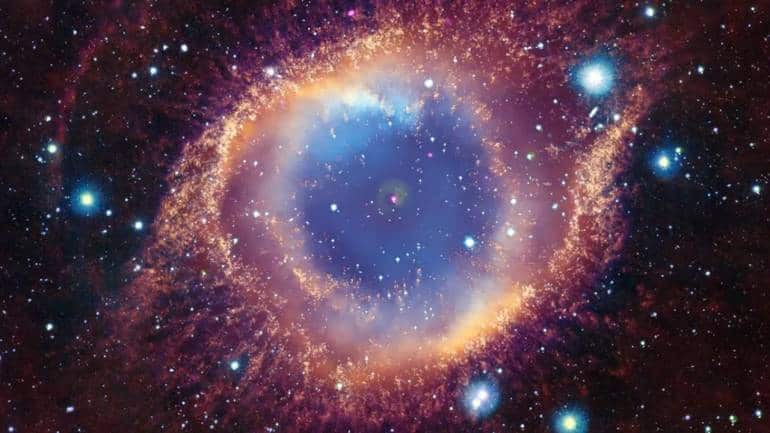 James Webb observes dying stars using powerful infrared instruments. (Image: NASA/CXC/SAO/Univ Mexico)
Yellow represents cooler regions where hydrogen molecules form. Red highlights cold dust and thinning gas at nebula edges. Each colour represents temperature and chemical composition differences.
Does study on dying star matter for scientists?
Studying dying stars helps scientists understand cosmic recycling processes. Elements expelled by stars later form planets and living organisms. Carbon, oxygen, nitrogen and iron originate inside stellar interiors. These elements become building blocks of future solar systems. Observations improve models of stellar evolution and galactic chemistry. They also help predict the future behaviour of our Sun.
Discover the latest Business News, Sensex, and Nifty updates. Obtain Personal Finance insights, tax queries, and expert opinions on Moneycontrol or download the Moneycontrol App to stay updated!
Find the best of Al News in one place, specially curated for you every weekend.
Stay on top of the latest tech trends and biggest startup news.





