






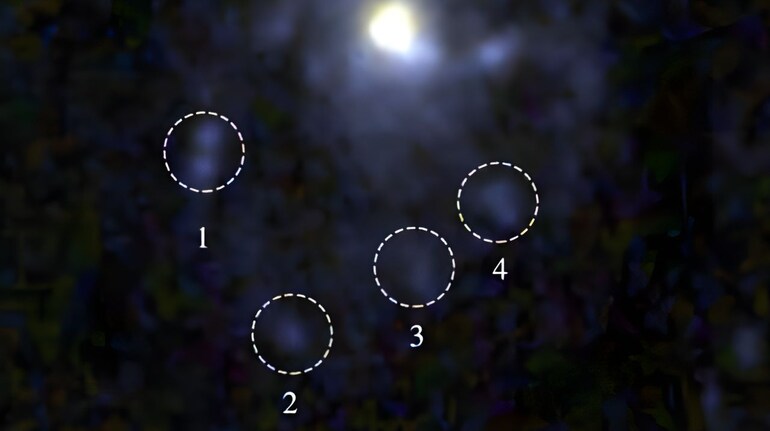

Far beyond our Milky Way, in a distant corner of the Universe, astronomers have spotted something extraordinary. They found a galaxy that appears to be trailing luminous “tentacles” through space. The discovery, made using the powerful James Webb Space Telescope, reveals a rare jellyfish galaxy located around 8.5 billion light-years away.
What Is a Jellyfish Galaxy?
The newly observed galaxy, known as COSMOS2020-635829, was detected in deep images of the well-studied COSMOS field. As the galaxy moves rapidly through a dense environment filled with hot gas, the surrounding medium pushes against it. This pressure strips away its gas, stretching it into luminous tails behind the galaxy.
Striking Appearance of Jellyfish Galaxy
What makes it remarkable is its striking appearance. With long streams of gas extending from the galaxy’s main disc, resembling the trailing tentacles of a jellyfish drifting through the ocean.
But these “tentacles” are not decorative. They are the result of a violent astrophysical process known as ram-pressure stripping.
James Webb’s Infrared Eyes See the Invisible
The discovery was made possible by the extraordinary sensitivity of the James Webb Space Telescope. Operating in infrared wavelengths, Webb can peer through cosmic dust and observe galaxies billions of light-years away.
At a distance of 8.5 billion light-years, this galaxy is seen as it existed when the Universe was roughly 5.3 billion years old which is less than half its current age.
Stars Born in the Wake of Destruction
Perhaps the most intriguing detail is what lies within the tentacles. Astronomers detected compact regions of intense star formation in the stripped gas meaning new stars are forming outside the galaxy’s main body.
This suggests that ram-pressure stripping does not simply deprive galaxies of the fuel needed for star formation. It can also trigger bursts of stellar birth in the displaced material itself.
A Glimpse Into the Universe’s Turbulent Youth
The cosmic jellyfish is more than a visually stunning object. It is a snapshot of the Universe in transition. This galaxy is caught between growth and loss, between star birth and gas depletion.
As astronomers continue to analyse Webb’s data, they hope to measure the speed of the stripping process, the rate of star formation in the tails, and the surrounding cluster’s properties.
Discover the latest Business News, Sensex, and Nifty updates. Obtain Personal Finance insights, tax queries, and expert opinions on Moneycontrol or download the Moneycontrol App to stay updated!
Find the best of Al News in one place, specially curated for you every weekend.
Stay on top of the latest tech trends and biggest startup news.





