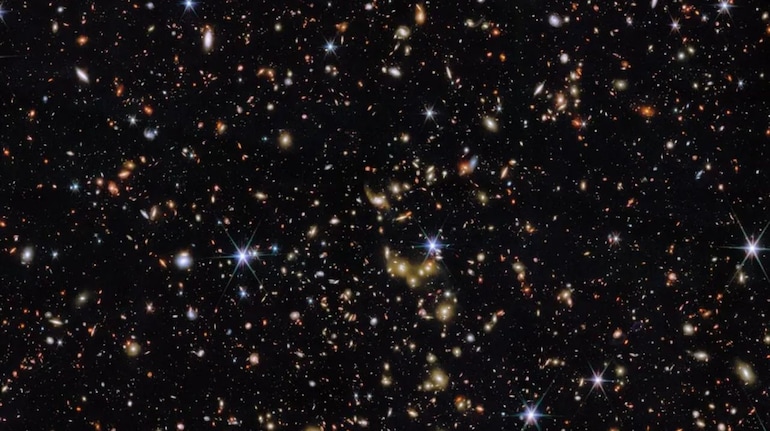
Gazing up at the night sky can feel peaceful. But far beyond what our eyes can see, the universe holds stories that stretch billions of years. Now, the James Webb Space Telescope (JWST) has captured one of those ancient tales — of galaxies forming families in the universe’s youth.
New Discovery in a Quiet Sky
Near the constellation Leo, JWST turned its gaze slightly aside. In the dim stars of Sextans, it spotted something astonishing. Thousands of galaxy groups were tucked deep in space, 12 billion light-years from Earth. These galaxies date back to a time when the universe was still young, just over a billion years old. The universe itself is 13.8 billion years old.
NASA confirmed that these 1,678 galaxy groups are held together by gravity. Just like stars orbit galaxies and planets orbit stars, galaxies orbit each other. These findings show how galaxies once looked wild and irregular, forming stars in large bursts. Over time, they evolved into more organised shapes like spirals and ellipses — including our own Milky Way.
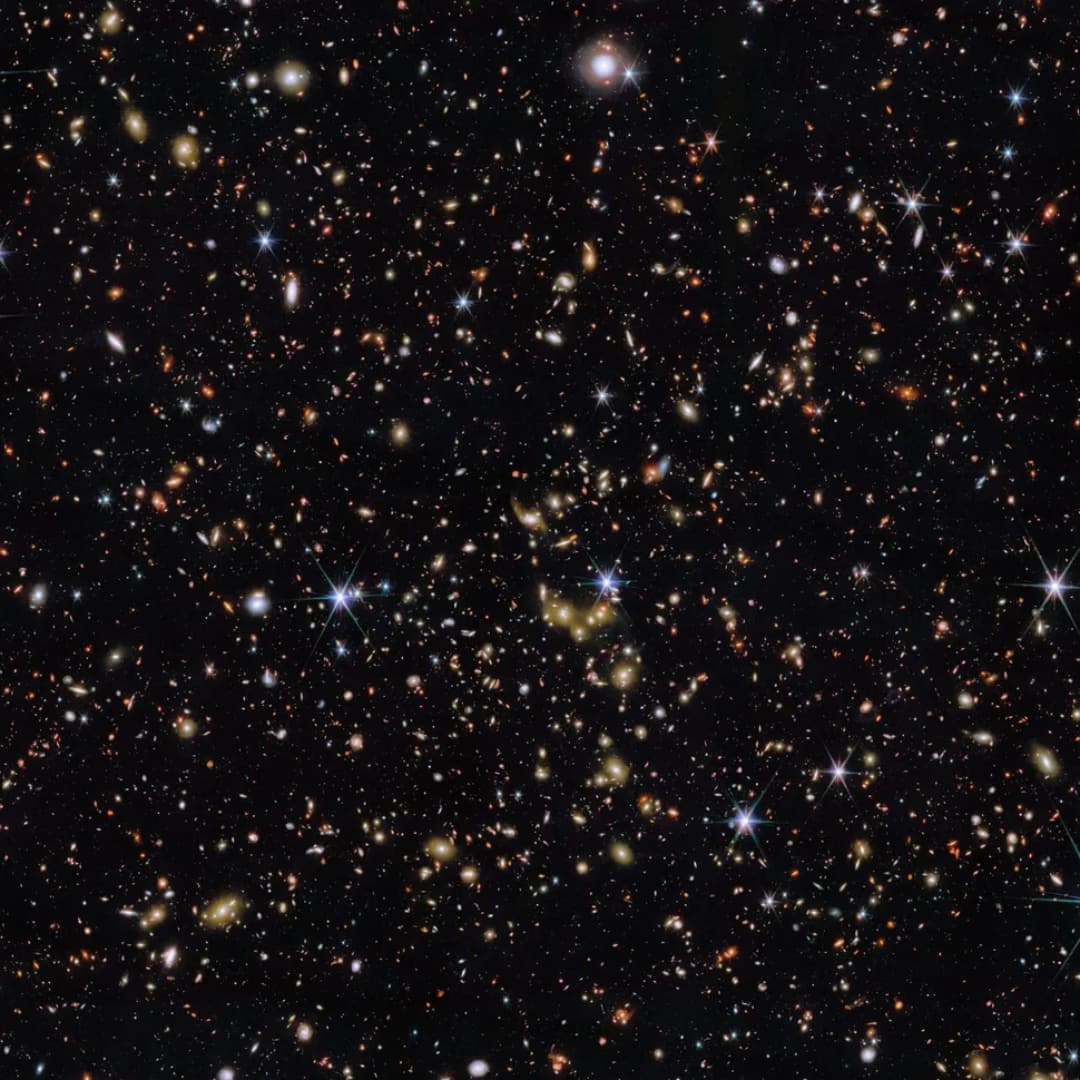 Webb Spots Thousands of Ancient Galaxies Huddled in Deep Space. (Image: NASA)
Galactic Families and Their Secrets
Astronomer Ghassem Gozaliasl, from Aalto University in Finland, led the study. He described galaxy groups as families forming in the cosmos. “Groups and clusters are really important,” he said in a statement. They allow galaxies to interact and merge, changing their shape and structure over time.
These deep-space groups also help scientists study other cosmic mysteries. Astronomers can learn more about dark matter, supermassive black holes and the invisible gas between galaxies by observing these clusters.
A Tradition of Looking Deep
NASA has a long tradition of looking into deep space. In 1995, the Hubble Deep Field showed about 3,000 distant galaxies. Then in 2004, the Hubble Ultra Deep Field revealed 10,000 galaxies, some from when the universe was only 800 million years old. Later came the Hubble eXtreme Deep Field, capturing 5,500 galaxies up to 13.2 billion light-years away.
The James Webb telescope has now taken that work further. In 2022, JWST revealed its first deep field, showing a cluster called SMACS 0723 as it was 4.6 billion years ago. In early 2023, it followed with a deep view of Pandora’s Cluster.
This latest find in Sextans marks another step in that journey. With each image, scientists get closer to understanding how the early universe shaped the one we live in today.
Discover the latest Business News, Sensex, and Nifty updates. Obtain Personal Finance insights, tax queries, and expert opinions on Moneycontrol or download the Moneycontrol App to stay updated!
Find the best of Al News in one place, specially curated for you every weekend.
Stay on top of the latest tech trends and biggest startup news.