






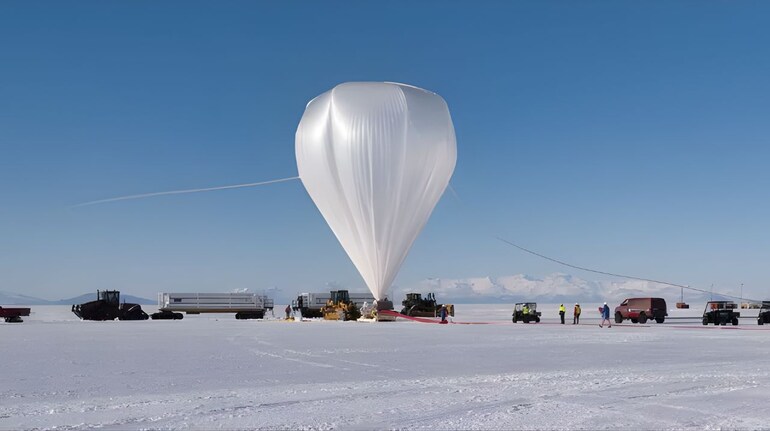

NASA has successfully completed a scientific balloon campaign over Antarctica that began in early December, involving four high‑altitude balloons launched near McMurdo Station on the Ross Ice Shelf. These balloons carried advanced instruments to study cosmic particles in Earth’s atmosphere. Researchers aimed to gather data that complements satellites and ground-based observatories globally.
What the Balloons are for?
Two primary instruments focused on the most extreme known cosmic phenomena. First is GAPS, the General AntiParticle Spectrometer which is used to search for anti-matter particles entering Earth. This lifted off on 15th December 2025 and returned back on January 9th of 2026. Anti-matter detection could provide valuable clues about the mysterious nature of dark matter.
Second is PUEO, the Payload for Ultrahigh Energy Observations. This looked for signals from neutrinos. This was launched on December 19, 2025. It stayed aloft for more than 23 days and landed back on January 12.
Do anything is supporting these Ballons?
Two smaller balloons carried additional scientific and calibration payloads during the campaign. They included radio beacons to test and validate the main instruments’ performance.
These support systems ensured data collection remained accurate during long-duration flights. The combination allowed multiple experiments to operate simultaneously in harsh conditions.
What will NASA's Balloon Campaign Do?
NASA’s Antarctic balloon campaign is designed to detect anti-matter and high-energy particles. The mission uses four high-altitude balloons launched above Antarctica during summer months. It aims to gather unique data on cosmic rays entering Earth’s upper atmosphere. The campaign complements satellites and ground-based observatories, offering a cost-effective research method.
What Does Antarctica Offer as Flight Condition?
Antarctica provides stable atmospheric conditions ideal for long-duration balloon flights. Continuous sunlight in summer allows balloons to remain aloft for several weeks straight. The region’s remote location reduces human interference and radio signal noise significantly. Researchers can reliably track particles and perform sensitive measurements without external disturbances.
How This Helps Science?
NASA's Balloon missions provide cost-effective data complementary to satellites and observatories worldwide. They allow study of cosmic rays, high-energy particles, and anti-matter entering Earth. Findings could improve our understanding of particle physics and astrophysical phenomena.
Discover the latest Business News, Sensex, and Nifty updates. Obtain Personal Finance insights, tax queries, and expert opinions on Moneycontrol or download the Moneycontrol App to stay updated!
Find the best of Al News in one place, specially curated for you every weekend.
Stay on top of the latest tech trends and biggest startup news.





