






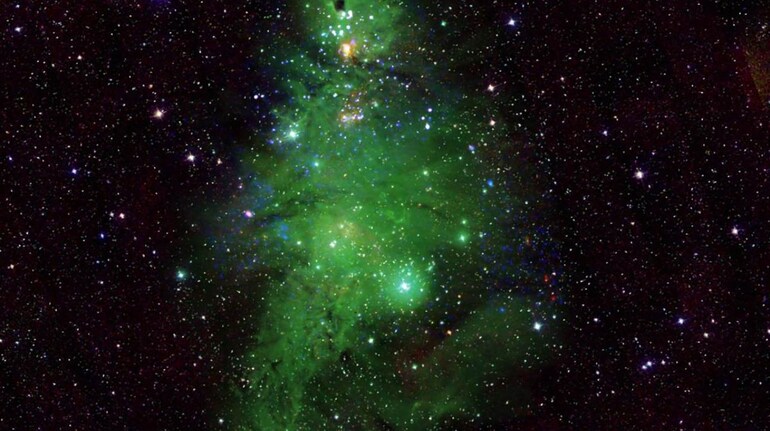

Christmas came early in the cosmos this year. NASA shared a stunning image that resembles a Christmas tree. The image captures a star cluster known as NGC 2264, about 2,500 light‑years away.
Bright young stars and glowing gas align in a pattern that mimics pine needles. NASA called it a cosmic greeting for the holiday season. But the discovery is more than a festive coincidence.
A Celestial Tree in Space
NGC 2264 is a nebula complex in the constellation Monoceros. It contains clusters of young, hot stars and glowing interstellar gas. The arrangement creates a shape strikingly similar to a Christmas tree.
Green-hued gas outlines the “branches,” while bright stars form the “ornaments” along the trunk. The effect is amplified in images combining optical and X‑ray data.
How NASA Captured This Cosmic Wonder?
The image combines data from optical telescopes and the Chandra X‑ray Observatory. X‑ray data reveal energetic young stars that ordinary telescopes cannot detect. Optical data highlight gas and dust structures glowing in visible light. Together, the datasets produce a spectacular, multi-layered image of the star cluster. It shows both the beauty of the cosmos and the power of modern astronomy.
Why This Discovery Matters?
Though visually festive, NGC 2264 provides crucial scientific insight. Young stars here are only a few million years old. Studying them helps scientists understand star formation processes. The surrounding gas and dust show how stars interact with their environment. It sheds light on how nebulae evolve over millions of years. These clusters also act as natural laboratories for studying stellar evolution.
What was the reason behind using this image?
NASA used the image to spread holiday cheer, blending science with cultural celebration. The resemblance to a Christmas tree reminds people that the universe can surprise us. Astronomy is not only about discovery, but it can also inspire wonder. The cluster demonstrates that science and art often overlap.
What NGC 2264 means for Future Research?
NGC 2264 will remain under observation for decades. Astronomers aim to track how young stars evolve and interact with gas clouds. They hope to better understand the early stages of star life cycles. The cosmic tree also highlights the importance of multi-wavelength astronomy.
Combining X-ray, infrared, and optical data reveals the universe in richer detail. This festive nebula is a reminder of both scientific discovery and imagination. It shows how the universe can surprise, delight, and educate simultaneously.
Discover the latest Business News, Sensex, and Nifty updates. Obtain Personal Finance insights, tax queries, and expert opinions on Moneycontrol or download the Moneycontrol App to stay updated!
Find the best of Al News in one place, specially curated for you every weekend.
Stay on top of the latest tech trends and biggest startup news.





