






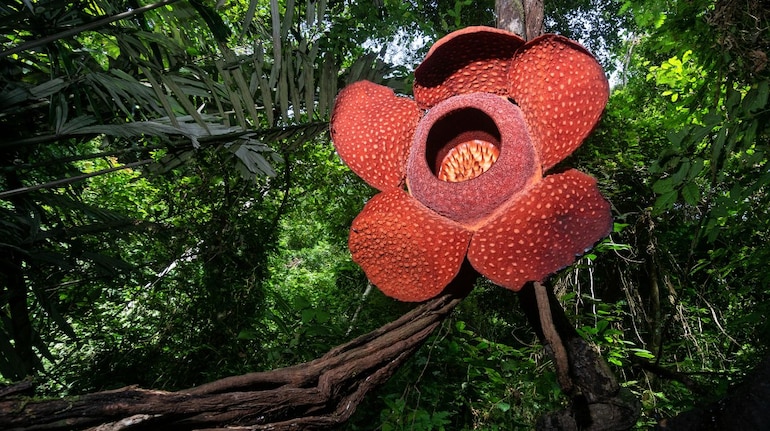

Deep within Southeast Asia’s rainforests grows Rafflesia arnoldii, the world’s largest single flower, famous for its immense size and its powerful odour of rotting flesh.
Rafflesia arnoldii and the World’s Largest Single Flower
Rafflesia arnoldii holds a unique botanical title. It produces the largest single bloom known. Each flower can span one metre across. Some blooms weigh nearly eleven kilograms. The flower appears alone, not clustered together. Other plants may look larger at first. Titan arum and talipot palm seem bigger. Yet their blooms contain many smaller flowers. Rafflesia produces one vast solitary blossom. Its petals look thick and fleshy. The surface appears wrinkled and deeply textured. Colours range from maroon to brick red. Pale wart like spots mark the petals. The bloom rests low on forest soil. Its presence feels dramatic and unusual.
Life as a Parasite in Rainforest Shadows
The plant grows in Sumatra and Borneo. It survives in primary and secondary forests. Conditions must remain dark and humid. Sunlight barely reaches the forest floor. Temperatures stay fairly constant year round. Rafflesia does not grow in soil. It lives entirely inside a host vine. The vine belongs to genus Tetrastigma. The flower depends on this vine completely. It draws water and nutrients from host. Botanists describe it as a holoparasite. It has no visible leaves or roots. For months it remains hidden from sight. Thread like strands spread within vine tissues. There is no outward sign of growth. Only when ready does a bud emerge. The bud forms near ground level. Many buds measure around thirty centimetres across. A record bud reached forty three centimetres. It was recorded on Mount Sago. Indonesian scientists refer to buds as knops.
The Corpse Flower’s Smell and Survival
When the bud opens it unfolds dramatically. Sometimes a faint hissing sound is heard. The bloom lasts only a few days. During this brief period it releases stench. The smell resembles decaying flesh strongly. This odour attracts flies and carrion insects. Pollinators are scarce on dark forest floors. The scent guides insects towards the flower. Insects then transfer pollen between blooms. Flowers are either male or female. Both sexes must bloom close together. Such timing rarely occurs in wild habitats. Successful reproduction therefore remains uncommon.
Rafflesia populations are small and localised. The plant relies on specific forest conditions. Habitat loss threatens both vine and flower. Forest clearing for agribusiness increases pressure. Tourism and harvesting have reduced some populations. The species lacks formal IUCN assessment. Conservationists still consider its future uncertain. In Indonesia the flower holds national status. It is one of three national flowers. White jasmine and moon orchid share honour. A presidential decree lists it as rare. Its survival now depends on forest protection.
Discover the latest Business News, Sensex, and Nifty updates. Obtain Personal Finance insights, tax queries, and expert opinions on Moneycontrol or download the Moneycontrol App to stay updated!
Find the best of Al News in one place, specially curated for you every weekend.
Stay on top of the latest tech trends and biggest startup news.





