






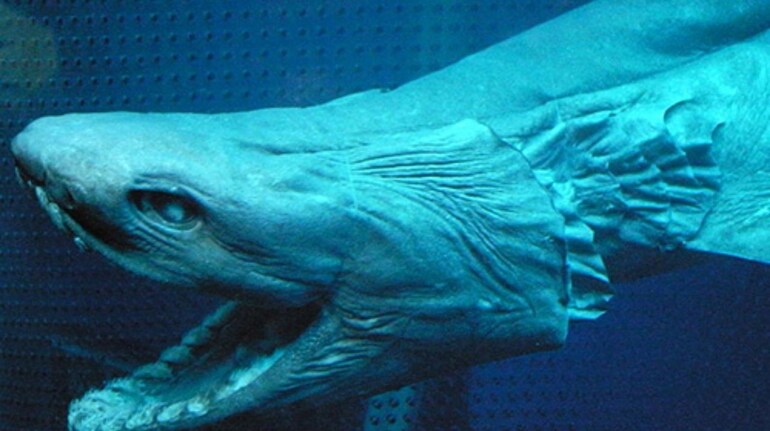

Scientists are examining the frilled shark, a deep-sea species whose ancient anatomy offers rare insight into early shark evolution and survival across mass extinctions.
Long before forests reshaped land and birds filled skies, sharks already ruled ancient oceans. Among them, the frilled shark survives as a rare lineage. It still inhabits deep waters today, largely unchanged anatomically. Scientists say its survival reveals how early vertebrates evolved. The species is formally known as Chlamydoselachus anguineus. It is also commonly called the lizard shark. Researchers describe it as one of the oldest-looking sharks alive.
Shark Origins That Predate Trees and Dinosaurs
Sharks appeared hundreds of millions of years before trees. Fossil evidence shows shark ancestors emerged over 420 million years ago. Trees appeared far later during the Devonian period. The frilled shark belongs to an ancient shark family. That family split early from modern shark ancestors. A 2013 study published in BioMed Research International traced this divergence. It placed the species near the base of shark evolution. This split occurred roughly 115 million years ago. That era coincided with dinosaurs dominating Earth’s landscapes.
This long separation explains its unusual appearance today. The frilled shark looks unlike most modern sharks. Its body is elongated and snake-like. Adults can reach nearly two metres long. Its movements are slow and deliberate. Scientists say this shape suits deep-sea living. Food is scarce and energy efficiency becomes essential. The shark also has six gill slits. Most modern sharks only have five. This trait reflects a very ancient anatomical condition.
Unique Teeth, Feeding Style and Slow Reproduction
The frilled shark’s jaw structure differs from modern sharks. Its jaws remain fixed and less flexible. Modern sharks usually extend their jaws outward. The frilled shark compensates with its teeth. It has over 300 sharp, needle-like teeth. Each tooth has three pointed cusps. This design helps grip slippery prey securely.
Stomach studies show its diet consists mainly of squid. Cephalopods make up about 60 percent of prey. It also eats small fish and sharks. Scientists believe it uses suction feeding. The shark lunges forward and expands its throat. This pulls prey inward quickly. Escape becomes nearly impossible once captured.
Research in the Japanese Journal of Ichthyology revealed another surprise. The species may have the longest gestation among fishes. Pregnancy may last up to three and a half years. The shark is ovoviviparous, with embryos developing internally. Young are born large and relatively developed. This slow reproduction suits deep-sea conditions.
Why an Ancient Shark Still Matters Today
Scientists caution against calling it evolutionarily frozen. Genetic studies show continued adaptation over time. Its features simply remain effective within its environment. The species offers a living window into ancient oceans. Researchers compare its genome with modern sharks. This helps identify ancient traits and later innovations.
Despite surviving multiple mass extinctions, new threats now emerge. Deep-sea fishing increasingly overlaps with its habitat. Accidental bycatch poses growing risks. Because reproduction is extremely slow, recovery would be difficult. Scientists warn human pressures operate faster than natural adaptation. A species older than forests may now face modern danger.
Discover the latest Business News, Sensex, and Nifty updates. Obtain Personal Finance insights, tax queries, and expert opinions on Moneycontrol or download the Moneycontrol App to stay updated!
Find the best of Al News in one place, specially curated for you every weekend.
Stay on top of the latest tech trends and biggest startup news.





