






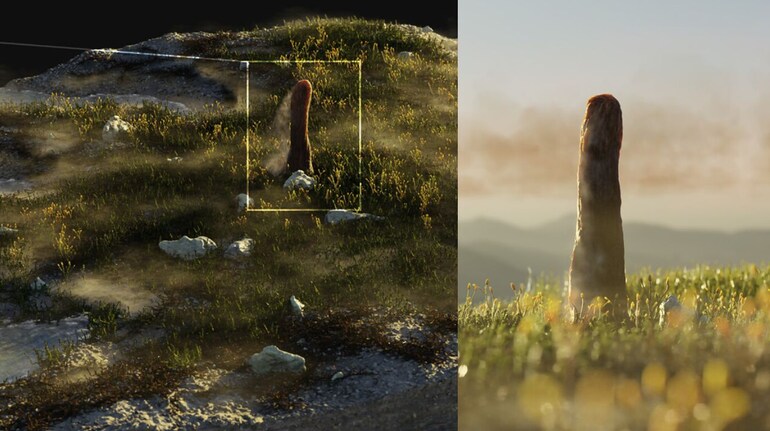

Earth has been home to every creature seen around the world. Whether humans or the oldest ancient sites, everything has its age, structure and detailed study. Some stories are mysterious, while others are slowly solved by scientists. But this log-shaped, 26-foot-tall giant, also known as Prototaxites taiti, has puzzled researchers for almost 165 years.
New research now suggests this ancient giant may belong to a completely unknown branch of multicellular life, rewriting what we know about early terrestrial organisms.
Prototaxites taiti: A Fossil Mystery 400 Million Years Old
Some fossils change how we see life on Earth, and Prototaxites taiti is one of them. Found in Devonian-period rock, this column-shaped organism grew up to 26 feet tall. For over 165 years, scientists debated what it was.
Initially, it was mistaken for a tree trunk, and later some thought it might be a giant fungus. But none of these explanations fully fit.
Advanced Analysis Reveals Something Extraordinary
Researchers from the University of Edinburgh used 3D imaging, molecular chemistry, and machine learning to examine the fossils. They discovered that P. taiti lacked chitin, the key molecule found in fungi. Its chemical composition is unlike any known plant or animal.
Machine-learning analysis confirmed it does not match any living branch of life. This organism may represent a completely extinct and unknown multicellular lineage. It was one of the largest terrestrial organisms of its time.
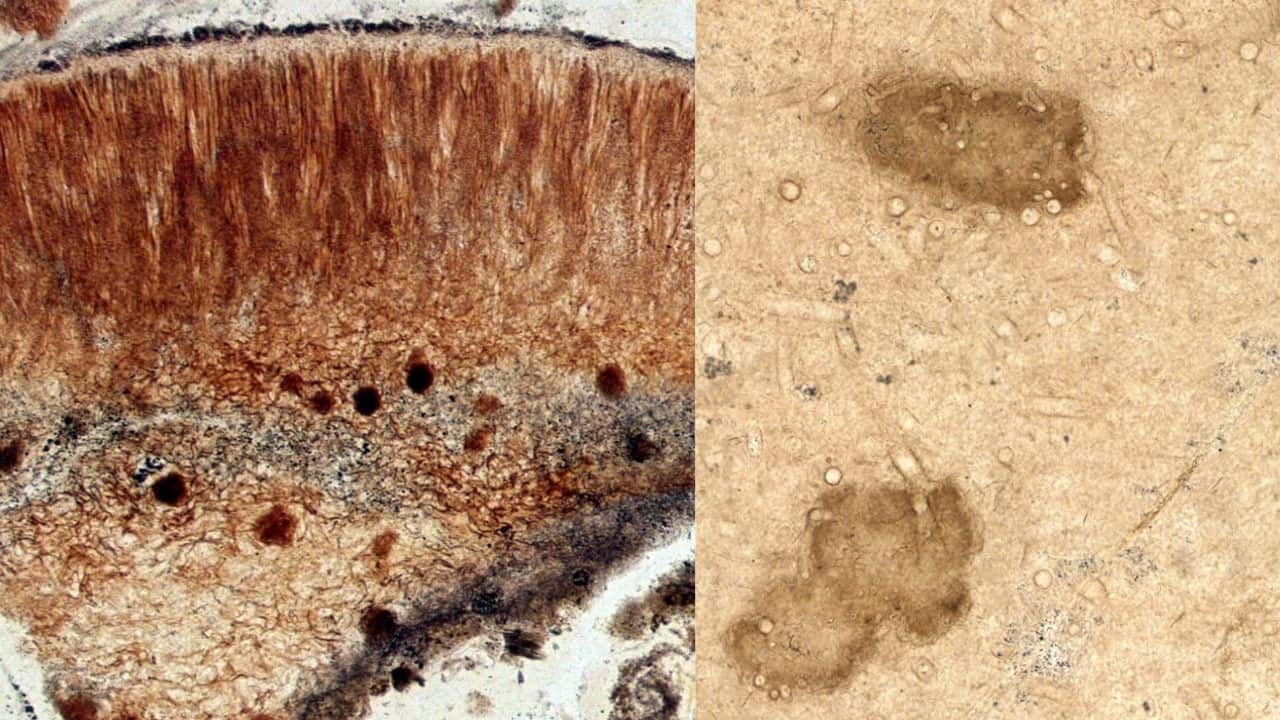 Prototaxites lacked chitin, a key fungal molecule. (Image: Science Advances)
Size and Scale of This Fossil Stunned Scientists
Some fossils are small, and some are gigantic, but Prototaxites taiti was enormous. It was the largest terrestrial organism of its time. It grew up to 26 feet (8 metres) tall, towering over early land plants. Its column-like shape could reach the height of a two-story building. This fossil dates back to the Devonian period.
Prototaxites Helps Unlock the Devonian Period
The Devonian period was a turning point for life on land. Prototaxites dominated landscapes before trees became common. It may have shaped soil, nutrients and habitats for other organisms. Scientists now consider it an evolutionary experiment lost to time. It is like a window into life 400 million years ago.
Why Scientists Called It an ‘Unknown Life Form’?
For over 165 years, scientists debated what it really was. They were unsure if this fossil was a tree, a fungus, or something else. Its anatomy did not match plants, animals, or fungi.
In 1859, Canadian geologist John William Dawson studied this fossil. He believed the fossils were decaying tree trunks and named them “first conifer”. The mystery has only grown as modern science applies new tools, yet the answers remain elusive.
What Are Scientists Planning Next?
Researchers plan to study more Prototaxites fossils found worldwide. Using AI and imaging, they hope to uncover hidden structures. Comparing ancient chemistry with modern plants and fungi will be a key focus.
Experts will also study other unknown multicellular organisms from the Devonian period. The hope is to reconstruct entire prehistoric ecosystems. Every fossil brings us closer to understanding life’s mysterious past.
Discover the latest Business News, Sensex, and Nifty updates. Obtain Personal Finance insights, tax queries, and expert opinions on Moneycontrol or download the Moneycontrol App to stay updated!
Find the best of Al News in one place, specially curated for you every weekend.
Stay on top of the latest tech trends and biggest startup news.





