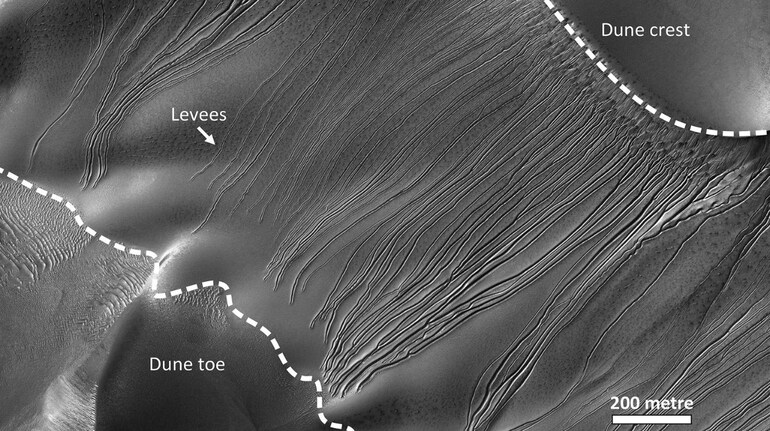
Could the Red Planet’s strange dunes reveal secrets of its past? A new study suggests that Mars’ mysterious gullies may not be carved by water but by exploding blocks of dry ice. Earth scientist Dr Lonneke Roelofs from Utrecht University recreated these Martian formations in her laboratory, uncovering a process that offers a glimpse into the planet’s unique landscape. The findings appear in Geophysical Research Letters.
How Did Scientists Recreate Mars’ Gullies on Earth?
For years, scientists believed carbon dioxide ice might play a role in shaping Mars’ surface. However, no one had ever observed this process in action. Roelofs decided to test the theory in a controlled setting. She and master’s student Simone Visschers travelled to The Open University in Milton Keynes, which houses a ‘Mars chamber’ capable of mimicking Martian conditions.
Supported by the British Society of Geomorphology, the team simulated dune slopes under low pressure and freezing temperatures. They released CO₂ ice blocks from the top of artificial slopes and observed their movement. “After finding the right angle, we finally saw results,” Roelofs said. “The ice began to dig into the slope like a burrowing mole or the sandworms in Dune. It looked very strange.”
What Causes These Gullies to Form on Mars?
During the Martian winter, temperatures drop to around minus 120 degrees Celsius. Thick layers of CO₂ ice form across the dunes. As spring arrives, sunlight warms the sand beneath the ice. The trapped CO₂ rapidly turns to gas through sublimation, causing pressure to build and the ice to burst.
“In our simulation, high gas pressure blasted sand in all directions,” Roelofs said. The ice block then dug deeper into the slope before sliding down, leaving behind long trenches with ridges on each side. These lab-made gullies closely matched those seen on Mars.
Why Does Mars Continue to Fascinate Scientists?
Roelofs studies how natural forces shape Martian landscapes. Her earlier work showed that sublimating ice could trigger debris flows along crater walls. This new research reveals a second process—one that sculpts gullies without the need for liquid water.
“Mars is our nearest neighbour and close to the solar system’s ‘green zone’, where liquid water could exist,” she said. “Understanding its landscape helps us ask new questions about life and planetary evolution.”
The research not only explains how Mars’ dunes change with the seasons but also reminds scientists how alien environments can reshape what we know about planetary geology — and perhaps, about life itself.
Discover the latest Business News, Sensex, and Nifty updates. Obtain Personal Finance insights, tax queries, and expert opinions on Moneycontrol or download the Moneycontrol App to stay updated!
Find the best of Al News in one place, specially curated for you every weekend.
Stay on top of the latest tech trends and biggest startup news.