






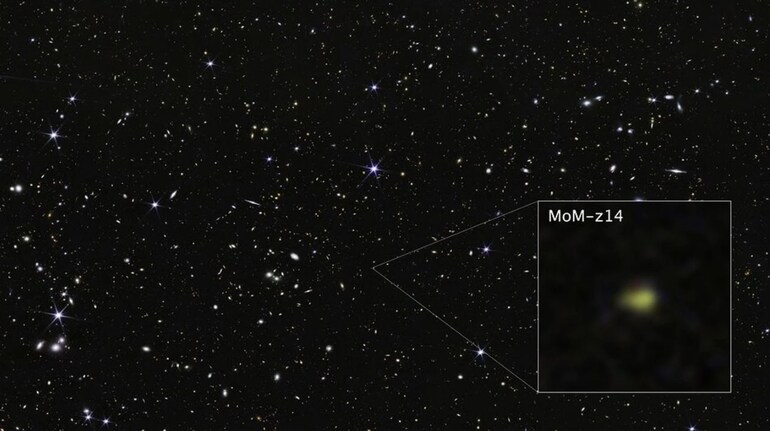

Astronomers using the James Webb Space Telescope have identified the most distant galaxy ever recorded, offering rare insight into the universe during its earliest known phase.
The galaxy, named MoM-z14, existed roughly 280 million years after the Big Bang, according to NASA. Its discovery pushes observational limits further back than previously possible and challenges current ideas about early cosmic development. Scientists say the galaxy appears unexpectedly bright, compact, and chemically evolved for such a young cosmic age.
Webb captured faint light that travelled more than 13.5 billion years before reaching Earth. That signal suggests MoM-z14 formed stars rapidly, enriching its environment sooner than models predict. Researchers say these features complicate existing theories describing how the first galaxies emerged.
What the telescope has revealed about MoM-z14
Rohan Naidu from the Massachusetts Institute of Technology described the findings as surprising. He said Webb is revealing a universe that looks very different from expectations. Naidu leads the research paper detailing MoM-z14, published in the Open Journal of Astrophysics and available through the arXiv preprint server.
The data shows strong nitrogen signatures within the galaxy. Scientists associate this chemical abundance with intense and early star formation. Such enrichment was not expected so soon after cosmic beginnings. Observations like these suggest early galaxies evolved faster than predicted.
Pascal Oesch from the University of Geneva stressed the importance of spectroscopy. He said distance estimates from images require confirmation through detailed spectral analysis. Such follow-up work ensures researchers understand what they observe and when it existed.
Why the discovery challenges early universe models
Scientists say MoM-z14 highlights a widening gap between theory and observation. Jacob Shen, a postdoctoral researcher at MIT, noted that current models struggle to explain these early galaxies. He said the growing mismatch raises important questions for future research.
Webb’s findings indicate more early galaxies than theories anticipated. Many also appear brighter and chemically richer than expected. This trend suggests star formation and galaxy assembly happened earlier and faster.
What astronomers expect next from Webb
Researchers plan deeper spectroscopic studies of MoM-z14 and similar objects. Comparing these galaxies with ancient stars inside the Milky Way may offer clues. Naidu likened this approach to archaeology, using stellar fossils to reconstruct cosmic history.
As Webb continues observing deeper into space, scientists expect further surprises. Each discovery reshapes understanding of the universe’s earliest chapters and the forces shaping its evolution.
Discover the latest Business News, Sensex, and Nifty updates. Obtain Personal Finance insights, tax queries, and expert opinions on Moneycontrol or download the Moneycontrol App to stay updated!
Find the best of Al News in one place, specially curated for you every weekend.
Stay on top of the latest tech trends and biggest startup news.





