






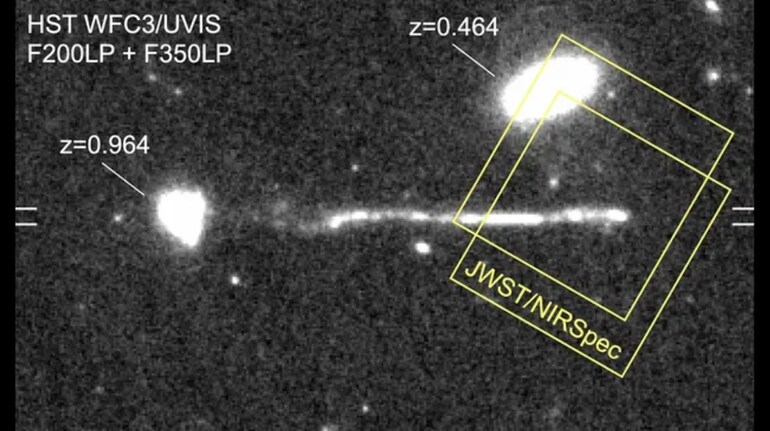

Astronomers say new observations in 2025 have strengthened evidence that runaway black holes are racing through distant galaxies, raising fresh questions about how often such extreme cosmic travellers form.
How Runaway Black Holes Gain Speed
Interest in cosmic visitors grew recently. Last year, a fast comet passed through. It travelled at 68 kilometres per second. Scientists imagined something far more dramatic. A black hole could move faster still. Speeds might reach 3,000 kilometres per second.
The idea traces back to Roy Kerr in the 1960s. He solved Einstein’s equations for spinning black holes. His work revealed crucial properties. Black holes have mass, spin and charge.
Later, Roger Penrose proposed energy extraction mechanisms. A spinning black hole stores immense energy. Up to 29% of mass is rotational. That energy can be released violently.
When two spinning black holes merge, gravitational waves erupt. If spins align in specific ways, waves surge asymmetrically. The merged object recoils like a rocket. Calculations show speeds of thousands kilometres per second.
Evidence From Gravitational Waves And Telescopes
Theory remained untested for decades. That changed in 2015 with detections. The LIGO and Virgo observed merging black holes. They detected characteristic chirps and ringdowns.
Ringdowns reveal the spin of remnants. Faster spins produce longer ringing signals. Data showed some black holes spun randomly. Many contained vast spin energy reserves.
In 2025, fresh studies reported striking images. One paper led by Pieter van Dokkum described unusual stellar streaks. Observations came from the James Webb Space Telescope. A distant galaxy showed a bright contrail. It stretched 200,000 light years long.
Researchers inferred a 10 million solar mass black hole. It appeared to travel near 1,000 kilometres per second. Another study examined galaxy NGC3627. A straight stellar trail crossed its disc. Scientists estimated a 2 million solar mass object. Its speed reached about 300 kilometres per second.
Could A Runaway Black Hole Reach Us
Such massive objects disrupt surrounding gas. Their gravity compresses interstellar material strongly. Stars form along their turbulent wakes. These contrails may persist millions years.
If giant runaways exist, smaller ones likely do. Gravitational wave data supports powerful recoil events. Some could even escape their host galaxies.
Astronomers say risks to our system remain tiny. Odds of a direct encounter are minuscule. Yet the findings expand cosmic understanding. Runaway black holes add new complexity. The universe appears more dynamic than imagined.
The study is published in arXiv.
Discover the latest Business News, Sensex, and Nifty updates. Obtain Personal Finance insights, tax queries, and expert opinions on Moneycontrol or download the Moneycontrol App to stay updated!
Find the best of Al News in one place, specially curated for you every weekend.
Stay on top of the latest tech trends and biggest startup news.





