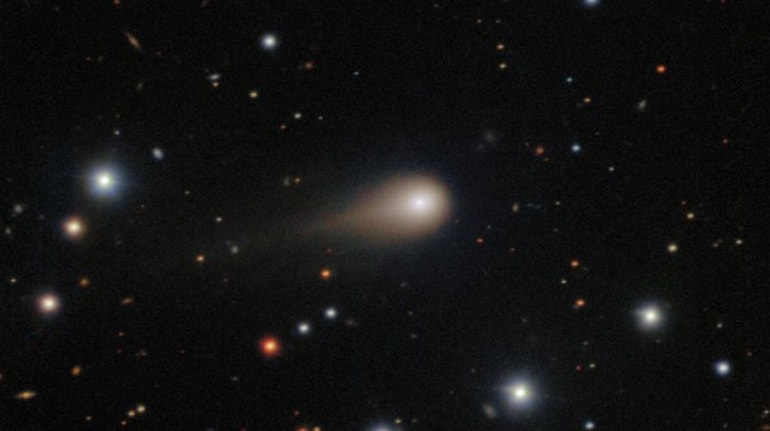
Astronomers are closely watching interstellar object 3I/ATLAS as it nears Earth this week. The rare visitor is revealing strange features that challenge long held ideas about comet behaviour beyond the solar system.
As of 14 December 2025, 3I/ATLAS was roughly 270.5 million kilometres from Earth. Scientists note its images are delayed by around 15 minutes. That delay occurs because light needs time to travel. On 19 December 2025, the object reaches closest approach. It will pass Earth at about 268.9 million kilometres. Researchers confirm the flyby poses no risk to Earth.
What Scientists Are Seeing From 3I/ATLASThe latest image was captured on 13 December 2025. It was taken using a 0.26 metre telescope. The observation came from Rayong in eastern Thailand. Astronomer Teerasak Thaluang reported the image publicly. Analysis shows a bright structure extending toward the Sun. Scientists call this feature an unusual anti tail.
Anti tails are rarely seen in comets. Typical comet tails extend away from the Sun. Solar radiation pressure usually pushes dust outward. In this case, material appears directed sunward. Researchers say this contradicts expected comet behaviour.
 An image of 3I/ATLAS was captured on 13 December 2025 at 21:30:26 UTC using a 0.26-meter telescope in Rayong, Thailand. At the comet’s distance of 271 million kilometres from Earth, the field of view spans 0.72 million kilometres per side. The bottom three panels display the projected brightness map in false colours and black-and-white, while the top panel presents a rotational-gradient brightness map processed with a Larson-Sekanina filter. A striking anti-tail, unusual for comets, extends sunward toward the lower left. (Image: Teerasak Thaluang)Why The Anti Tail Defies Explanation
Anti tails can appear due to viewing angles. This occurs when Earth crosses a comet’s orbital plane. Scientists say that explanation does not apply here. The feature appeared in a Hubble image from July. It remained visible in images taken in November. Thousands of observations confirm its persistent presence.
In July, the object was approaching the Sun. By November, it was moving away again. Despite this change, the anti tail remained visible. Researchers believe a physical process is responsible.
What Scientists Think Could Be Happening NextThe mystery was not discussed at a NASA briefing. That press conference took place on 19 November 2025. Since then, scientists have proposed new explanations. Two peer reviewed papers were co authored with Eric Keto. They suggest sunlight scatters off icy fragments shed sunward.
These icy particles may evaporate quickly near the Sun. Radiation pressure may not act fast enough. A third paper was published on 8 December 2025. It links the feature to trailing material affected by acceleration. Data from JPL Horizons supports unusual non gravitational forces.
Scientists say upcoming Hubble analysis could favour one theory. The object will soon exit the inner solar system. Researchers say this makes current observations especially important.
Discover the latest Business News, Sensex, and Nifty updates. Obtain Personal Finance insights, tax queries, and expert opinions on Moneycontrol or download the Moneycontrol App to stay updated!
Find the best of Al News in one place, specially curated for you every weekend.
Stay on top of the latest tech trends and biggest startup news.