






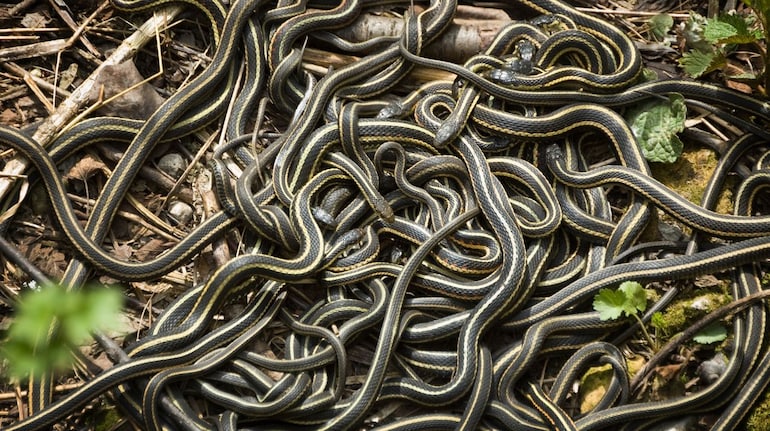

Visitors are gathering in Manitoba to witness one of the planet’s largest wildlife spectacles, as tens of thousands of red sided garter snakes emerge from winter hibernation at the Narcisse Snake Dens on 13 February 2026. The site has drawn global attention for hosting the world’s biggest known concentration of snakes.
Narcisse Snake Dens in Manitoba
Anyone fearful of snakes may wish caution. The Narcisse Snake Dens sit within rural grassland and forest. The reserve lies in Manitoba, Canada. It is located in the Rural Municipality of Armstrong. Beneath the soil rests porous limestone bedrock. Over millions of years, water shaped caverns. Deep crevices formed through slow erosion.
These sinkholes reach several metres underground. They extend below the winter frostline. Yet they remain above the water table. Surface temperatures often drop to minus 30C. Inside the caverns, conditions stay above freezing. This balance creates an ideal refuge. It shelters vast numbers of snakes.
Red sided garter snakes winter hibernation
The species here is widely distributed. The red sided garter snake is common. Its scientific name is Thamnophis sirtalis parietalis. The snakes show red spots and yellow stripes. They inhabit northern United States regions. They also range across southern Canada. During warmer months they prefer wetlands. Frogs form their primary food source.
As autumn advances, behaviour changes noticeably. Snakes migrate towards the limestone dens. Movements begin in late September annually. They continue through early October weeks. The reptiles remain underground for months. Hibernation lasts five to six months. Four active dens operate at Narcisse. Numbers can reach up to 100000. This total marks a world record gathering.
Snakes depend on external warmth sources. Winter dormancy slows their metabolism significantly. When spring sunlight warms the ground, activity resumes quickly.
Spring mating balls and pheromone signals
Males emerge before females each spring. Both sexes focus on reproduction. Females release powerful pheromone blends. Males detect scents using specialised organs. The vomeronasal organ guides male pursuit. It sits along the mouth roof.
Soon hundreds cluster around one female. Observers describe writhing mating balls forming. Males rub chins along female spines. They attempt alignment for successful mating. Each male carries two hooked hemipenes. One is inserted into the cloaca. Sperm and a gelatinous plug follow. The plug blocks rival mating attempts.
Most males favour their right hemipenis. It is larger than the left. It also produces a bigger plug. Scientists believe this improves paternity chances. For visitors, the spectacle remains unforgettable.
Discover the latest Business News, Sensex, and Nifty updates. Obtain Personal Finance insights, tax queries, and expert opinions on Moneycontrol or download the Moneycontrol App to stay updated!
Find the best of Al News in one place, specially curated for you every weekend.
Stay on top of the latest tech trends and biggest startup news.





