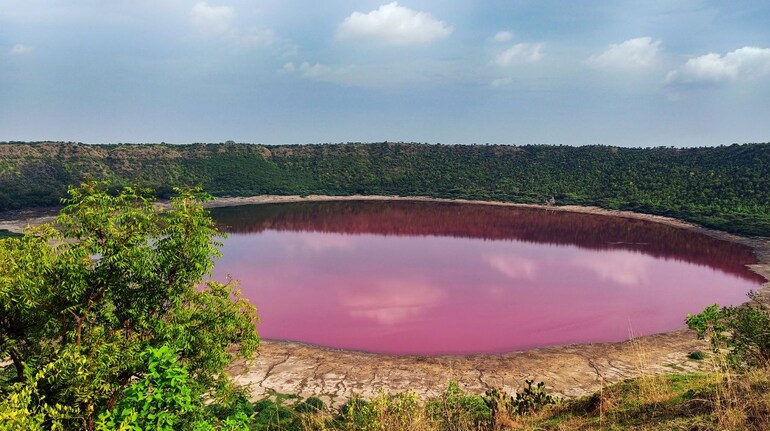

In central India, a remote lake continues puzzling scientists and visitors alike. Lonar Lake, hidden within Maharashtra’s Buldhana district, changes colour without warning. Formed by a meteor impact thousands of years ago, it defies geological expectations. Researchers say the lake behaves unlike any other water body. Its shifting colours raise questions about Earth’s ancient past.
Lonar Lake sits inside a near perfect circular crater. Scientists estimate the impact occurred about 50,000 years ago. The crater measures 1.2 kilometres across and 150 metres deep. Steep hills surround the lake, rising sharply from its rim. The water inside is seven times saltier than seawater. Despite this salinity, life continues to flourish inside.
Why Lonar Lake Changes Colour
The lake’s colour varies between blue, green, and pink. These changes depend on seasons and water chemistry. High salinity and alkaline conditions shape microbial growth. Certain microorganisms release pigments into the lake water. Halobacteriaceae and Dunaliella salina create reddish hues. Green shades appear when algae populations increase rapidly. Scientists describe the lake as a living laboratory.
The lake’s mixed saline and alkaline water surprises experts. Many researchers say such coexistence should not occur naturally. Satellite studies and chemical testing confirm this rare balance. The lake offers insights into extremophile survival. These organisms thrive where few others could survive. Their presence explains the lake’s dramatic visual transformations.
A Window Into Earth And Space
Lonar Lake also holds clues to planetary history. It is the only impact crater within Deccan basalt rock. This basalt formed during volcanic eruptions 65 million years ago. The meteor impact shattered rock, forming glassy maskelynite material. The Geological Survey of India protects the site.
NASA scientists noticed similarities between Lonar and lunar surfaces. A study by IIT Bombay analysed lake soil minerals. Researchers found similarities with Apollo mission moon rocks. The findings suggest Lonar can model lunar geology. Scientists believe it helps study astrobiology and planetary impacts.
Faith, Heritage And Conservation Concerns
Beyond science, the lake holds deep cultural significance. Local communities consider the lake spiritually sacred. Ancient temples surround the crater, dating to the 6th century CE. Legends link the lake to Lord Vishnu. Some beliefs say Lord Ram once visited the site.
Compasses reportedly fail near parts of the crater. Scientists attribute this to unique geological properties. The lake became a Ramsar wetland site in November 2020. Authorities recognised its ecological and cultural importance.
However, threats continue to grow around Lonar Lake. Pollution, encroachment, and invasive species pose risks. Conservationists warn damage could be irreversible. Protecting the lake now remains a pressing challenge.
Lonar Lake continues changing, questioning what humans truly understand.
Discover the latest Business News, Sensex, and Nifty updates. Obtain Personal Finance insights, tax queries, and expert opinions on Moneycontrol or download the Moneycontrol App to stay updated!
Find the best of Al News in one place, specially curated for you every weekend.
Stay on top of the latest tech trends and biggest startup news.