






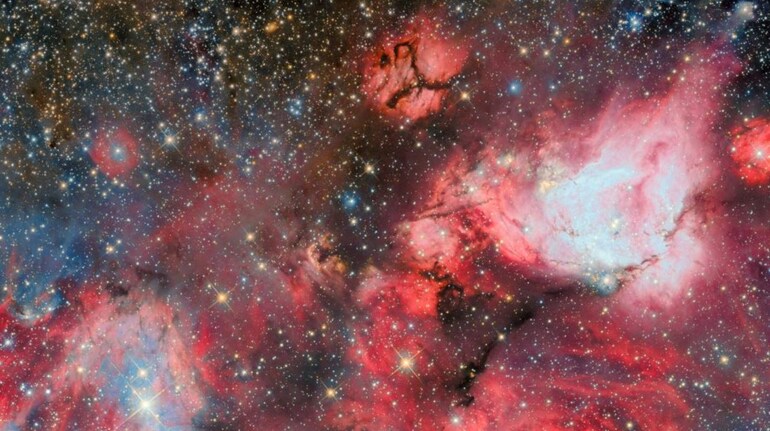

A newly released Hubble Picture of the Week reveals a vast stellar nursery, offering astronomers a closer look at how stars are forming inside the enormous N159 gas cloud within a neighbouring galaxy.
Hubble image shows active star formation in N159
The image focuses on N159, a huge cloud dominated by cold hydrogen gas. Hydrogen remains the universe’s most abundant element and forms stars everywhere. This cloud sits about 160,000 light-years from Earth. It lies within the constellation Dorado, well beyond the Milky Way.
N159 is part of the Large Magellanic Cloud, a dwarf galaxy orbiting our own. Because this galaxy is relatively close, scientists can observe star birth clearly. N159 is among the most massive star-forming regions there. Astronomers consider it a key laboratory for understanding stellar origins.
Vast cold hydrogen cloud fuels new stars
Hubble’s view captures only part of the larger N159 complex. The full structure stretches across more than 150 light-years. One light-year measures how far light travels annually. That distance makes N159 nearly 10 million times wider than Earth’s orbit. Such immense size allows sustained star formation over millions of years.
Inside the cloud, temperatures plunge far below freezing levels. Gravity slowly pulls gas inward, increasing density within pockets. These dense regions continue collapsing until nuclear reactions ignite. That moment marks the birth of new stars. Many young stars remain wrapped inside dust and gas.
Stellar feedback reshapes the surrounding gas
Some newly formed stars shine intensely within the cloud. Massive young stars release strong radiation and energetic stellar winds. These forces heat nearby hydrogen gas, causing a red glow. Hubble detects this glow with exceptional sensitivity. In several areas, hollow bubble-like structures appear clearly.
These cavities form as stellar winds push gas outward. This process is known as stellar feedback. Feedback can halt star formation nearby by clearing material away. In other regions, it may compress gas and trigger births elsewhere. Over time, feedback reshapes the entire cloud structure.
New wavelengths offer deeper insight into N159
Hubble previously released a full image of N159 in 2016. The latest version includes data from an added wavelength. This expanded view highlights hot gas around newborn stars more clearly. Astronomers can now trace interactions between stars and gas better. The enhanced image shows how young stars transform their surroundings.
Scientists say such views improve understanding of galaxy evolution. By studying regions like N159, astronomers learn how stars shape galaxies. These observations help explain how similar processes shaped the Milky Way long ago.
Discover the latest Business News, Sensex, and Nifty updates. Obtain Personal Finance insights, tax queries, and expert opinions on Moneycontrol or download the Moneycontrol App to stay updated!
Find the best of Al News in one place, specially curated for you every weekend.
Stay on top of the latest tech trends and biggest startup news.





