







Far beyond the orbit of Saturn, Neptune spins silently, wrapped in swirling clouds of brilliant blue that hide a chaotic secret. Beneath that serene surface, its magnetic field behaves strangely, tilted, off-center and completely unlike Earth’s neat north and south poles.
Scientists have long wondered what could create such disorder and now a bizarre form of water ice. This only exist under extreme pressures and temperatures, that might finally hold the answer to Neptune’s magnetic mystery.
What Is Hot Black Ice?
Hot black ice is not like normal frozen ice. Deep inside Neptune, water faces immense pressures and extreme heat. It transforms into superionic ice, a strange hybrid state. The oxygen atoms form a lattice while hydrogen atoms freely flow. This unusual structure conducts electricity unlike any regular ice does. Its light absorption makes it appear black, though molten-hot inside.
Who Is Studying Hot Black Ice?
Deep inside physics and planetary science laboratories around the world, teams of researchers are chasing water in its most extreme form. At the SLAC National Accelerator Laboratory, physicists led by Leon Andriambariarijaona.
Scientists are creating superionic water in labs on Earth. They use diamond anvils and powerful lasers to compress water. This mimics pressures and temperatures deep inside Neptune and Uranus.
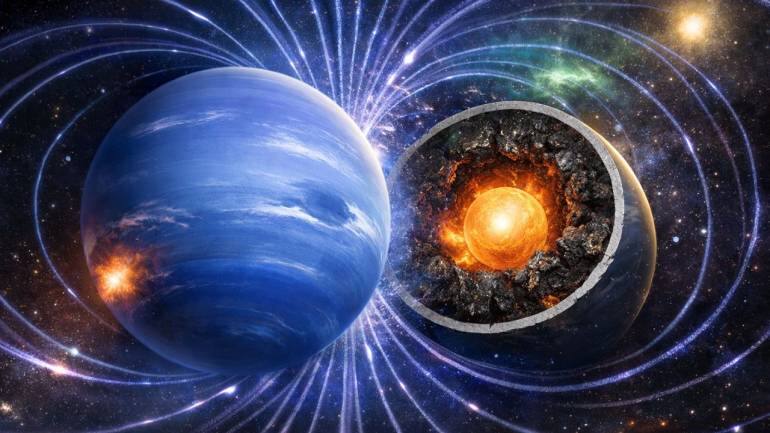 Neptune spins in silence, wrapped in blue clouds. (Image: Canva)
Neptune’s Magnetic Field Mystery
When NASA’s Voyager 2 spacecraft flew past Neptune, scientists were shocked by what they found. Neptune's magnetic field is tilted relative to its rotation. It is offset from the planet’s center. This planet does not resemble the smooth dipole pattern we see on Earth. For decades, this wild field puzzled researchers, who struggled to explain how such chaos could form deep inside a planet.
How Hot Black Ice Could Solve It?
Researchers recreated Neptune’s interior in labs on Earth carefully. They used diamond anvils and high-powered lasers to compress water. X-ray diffraction revealed a messy, irregular lattice of superionic ice.
This allowed uneven flows of electrically charged hydrogen particles. Planetary magnetic fields are generated by flowing electrically charged particles. The chaotic ice could naturally produce Neptune’s tilted field easily.
Why This Discovery Matters?
Hot black ice may exist in all ice giants’ cores. It explains Uranus, Neptune and possibly distant exoplanets’ magnetism. It shows water behaves strangely under unimaginable pressures and temperatures. Superionic ice links internal structure with magnetic field phenomena clearly.
Discover the latest Business News, Sensex, and Nifty updates. Obtain Personal Finance insights, tax queries, and expert opinions on Moneycontrol or download the Moneycontrol App to stay updated!
Find the best of Al News in one place, specially curated for you every weekend.
Stay on top of the latest tech trends and biggest startup news.





