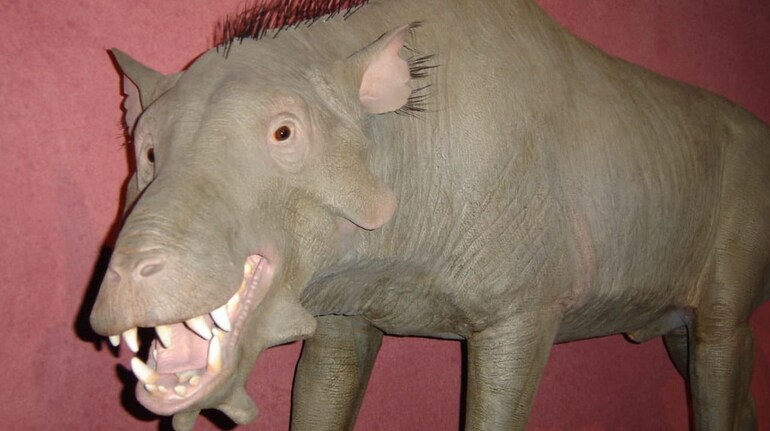
A quiet fossil gallery once felt still and silent. Then a huge skull hinted at a forgotten diet. Its worn teeth offered clues to behaviour long lost.
What did these ancient hell pigs eat?
New research suggests large Archaeotherium species crushed hard items. Their teeth held wear patterns linked with bone consumption. Smaller species seemed to slice softer food instead. The findings came from work by Brynn Wooten in Tennessee. She shared early results at a 2025 science meeting. The meeting was held by the Society of Vertebrate Palaeontology. The study has not yet been reviewed formally.
How big were these prehistoric creatures?
Archaeotherium lived across North America for millions of years. Some individuals stood almost as tall as humans. Their weight could exceed one thousand kilograms easily. Their bodies looked pig-like but held different origins. They were closer to whales and hippos genetically. Their huge heads formed nearly thirty percent of length. Yet their brains were remarkably small for their size.
 Archaeotherium skeleton. Image: Los Angeles County Museum of Natural History/ Wikimedia Commons)
How did researchers study their feeding habits?
Wooten worked with Larisa DeSantis at Vanderbilt University. They examined fossil teeth from several American states. Places included Nebraska, Oregon, Colorado and South Dakota. They used dental microwear texture analysis for results. This method creates precise three-dimensional tooth scans. The patterns revealed varied feeding roles across species. Large Archaeotherium matched lions and hyenas in wear. Smaller species showed textures like modern peccaries.
What might these findings mean for behaviour?
Large species may have scavenged carcasses more often. They could have forced predators away from kills. They may also have eaten tough plants or woody items. SmaScott Heath / CC BY 2.0/flickrller species likely fed on leaves and grasses. The analysis cannot yet confirm exact prey species. Wooten plans isotope testing to answer these questions. She hopes to confirm whether bone formed part of diets.
Discover the latest Business News, Sensex, and Nifty updates. Obtain Personal Finance insights, tax queries, and expert opinions on Moneycontrol or download the Moneycontrol App to stay updated!
Find the best of Al News in one place, specially curated for you every weekend.
Stay on top of the latest tech trends and biggest startup news.