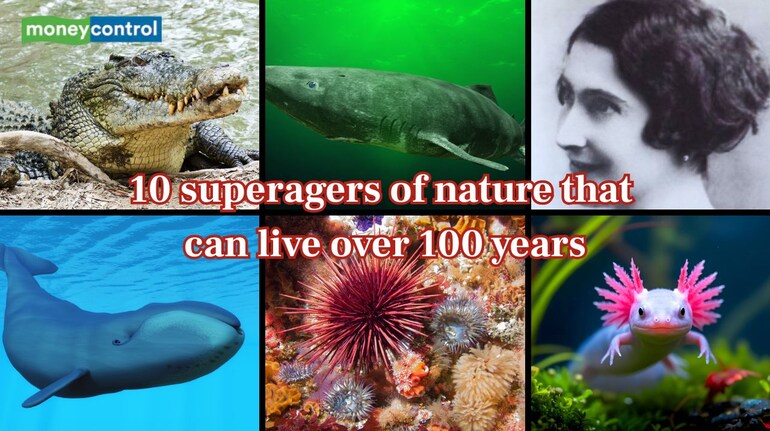
Some animals seem to laugh at passing centuries. While humans hail centenarians, many animals live centuries, defying biology and confounding scientists. From sharks to sponges, nature has incredible long-living animals.
Greenland Shark: The Longest-Living Vertebrate
A 2016 study found Greenland sharks live centuries. Scientists used eye tissue to estimate one at 392 years old. These sharks live in the cold north Atlantic, including Canada and Scandinavia. They are adapted to cold waters, growing slowly with an extremely low metabolism. This slow growth accounts for their remarkable longevity, with possible lifespans of over 500 years.
 (Image: Canva)
Glass Sponge: The Ancient Deep-Sea Survivor
Glass sponges live in deep oceans around the world, filtering seawater silently. They stay anchored to the seabed, growing over vast periods of time. One species, Monorhaphis chuni, creates long spicules over nine feet. A specimen from the East China Sea was dated between 8,000 and 14,000 years old. Colonies live in silence, making them some of Earth’s oldest organisms.
 (Image: NOAA's National Ocean Service)
Ocean Quahog Clam: Centuries Under the Sea
Ocean quahog clams are bivalves living near Britain, Iceland, and America. They grow slowly, shielded by dull grey shells reaching five inches Many survive for two centuries, with some living longer. One specimen collected near Iceland in 2006 lived 405 years. Nicknamed “Ming”, it was born during China’s Ming Dynasty.
 (Image: Canva)
Tubeworm: The Deep-Sea Invertebrate Superager
Tubeworms attach themselves to vents and cold seeps. They lack mouths and stomachs, relying on bacteria for food. Their tubular bodies may reach eight feet long underwater. One species, Escarpia laminata, is known for great longevity. These creatures can live between 100 and 200 years. Some live over 300 years, thanks to their slow metabolism in deep oceans.
 (Image: Canva)
Freshwater Pearl Mussel: The Longest-Lived Mollusc
Freshwater pearl mussels thrive in rivers across Europe. They bury themselves in stream beds from Norway to Spain. Most fail to survive their first year, washed away as larvae. Those that endure may live more than 250 years. The oldest known individual reached 280 years, thanks to a slow metabolism and delayed maturity until age twenty.
 (Image: Canva)
Bowhead Whale: The Arctic Giant Mammal
Bowhead whales inhabit icy northern seas, from the Atlantic to the Bering. Many live over 100 years, with some approaching 200. These whales reach sixty feet, making them the second largest after blue whales. Genetic studies show mutations that protect against cancer. Scientists believe these genes, linked with cell repair, slow their ageing process significantly.
 (Image: Canva)
Red Sea Urchin: The Eternal Spined Wanderer
Red sea urchins live in the Pacific from Alaska to Baja. Some also inhabit the northern coasts of Japan. They form groups on rocky beds, moving little if food is plentiful. With spiny purple shells, they can live 100 to 200 years. Remarkably, they show negligible ageing, keeping strong shells and steady immune genes over time.
 (Image: Canva)
Saltwater Crocodile: The Coastal Predator Superager
Saltwater crocodiles are the largest reptiles alive, often reaching 22 feet. In the wild, most live 40 to 60 years. Yet in captivity, some endure over 100 years. A famous male called Cassius in Australia lived beyond 110. Their habitats stretch across northern Australia, Indonesia, and New Guinea, where rivers and coasts are suitable for their heavy-built bodies.
 (Image: Canva)
Human Centenarians: Defying the Expected Limit
Humans also have their own share of remarkable lifespans. Jeanne Calment of France lived 122 years, a confirmed record. In 2021, 89,739 Americans were over 100 years old. Numbers doubled in two decades, indicating better health. Japan leads the world with over 94,000 centenarians. Around 85% are women, perhaps due to hormone differences that slow disease.
 Jeanne Calment’s (Image: Guinness World Records)
Axolotl and Bat Comparisons: Rethinking Lifespan Rules
Not all longevity follows size, as once believed. Elephants outlive mice, yet bats defy this expectation easily. Mice survive only four years, but bats live 24. Scientists think lifespan depends on cell repair, metabolic rate, and unknown factors. These puzzles remind us that life’s clocks tick differently across species.
 (Image: Canva)
Discover the latest Business News, Sensex, and Nifty updates. Obtain Personal Finance insights, tax queries, and expert opinions on Moneycontrol or download the Moneycontrol App to stay updated!
Find the best of Al News in one place, specially curated for you every weekend.
Stay on top of the latest tech trends and biggest startup news.