






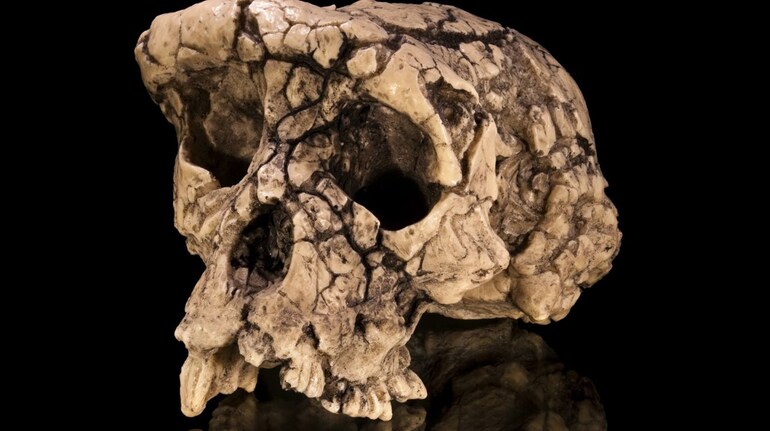

Fossils of one of humanity’s earliest relatives suggest it walked upright, according to new research led by New York University paleoanthropologists. The study provides the strongest evidence yet that Sahelanthropus tchadensis, discovered in 2001, possessed adaptations for bipedal locomotion while retaining arboreal abilities.
Bipedal Traits Revealed in Limb Bones
The team focused on a femur and two partial forearm bones recovered from Toros-Menalla in Chad. Earlier studies argued the bones were too apelike to support upright walking. Using 3D shape modelling and anatomical analysis, researchers found traits linked to human-style locomotion.
The femur displayed a small bony projection, the femoral tubercle, an attachment for the iliofemoral ligament, essential for stabilising the hip during bipedal walking. This feature has previously been identified only in hominins.
 From left to right: bones of a chimpanzee, Sahelanthropus tchadensis, and an Australopithecus species. (Image: Scott Williams / NYU and Jason Heaton / University of Alabama at Birmingham)
Internal Torsion Supports Upright Walking
The femur also showed pronounced antetorsion, a medial twist that aligns the knees beneath the body’s centre of mass. This torsion pattern is exclusive to hominins and differs from both living apes and extinct Miocene species. While the external shape of the bones resembled chimpanzees, their proportions, including arm-to-leg ratios, were more hominin-like, indicating a transitional form of bipedalism.
A Gradual Evolution of Bipedalism
Researchers argue that bipedalism emerged gradually rather than suddenly. Sahelanthropus tchadensis likely engaged in terrestrial bipedal walking, but also retained arboreal behaviours such as climbing, branch-suspension, and quadrupedal movement. “These fossils suggest that early hominins evolved from a Pan-like Miocene ape ancestor,” Dr. Scott Williams of NYU said. The study reinforces the idea that chimpanzee-like creatures were near the root of the human family tree.
The findings challenge long-standing assumptions about the evolution of upright walking. Sahelanthropus tchadensis may represent an early form of habitual, though not obligate, bipedalism. The research, published this month in Science Advances, provides direct evidence that bipedalism was an early adaptation in the human lineage, emerging from ancestors that resembled today’s chimpanzees and bonobos.
Discover the latest Business News, Sensex, and Nifty updates. Obtain Personal Finance insights, tax queries, and expert opinions on Moneycontrol or download the Moneycontrol App to stay updated!
Find the best of Al News in one place, specially curated for you every weekend.
Stay on top of the latest tech trends and biggest startup news.





