






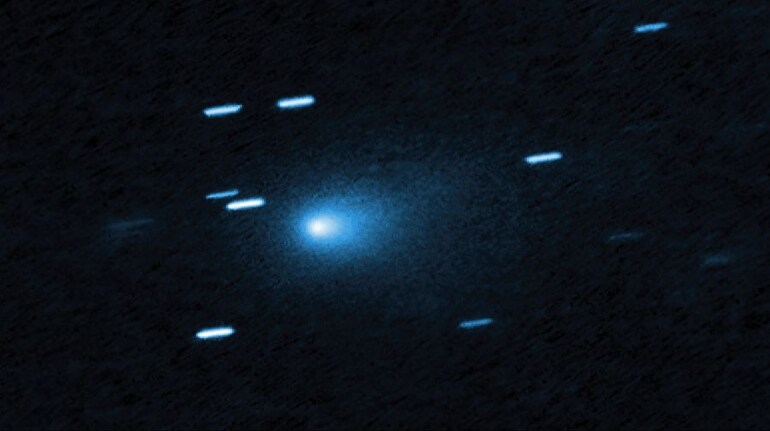

A rare interstellar visitor known as Comet 3I/ATLAS is making its final appearance, giving skywatchers one last opportunity to observe the icy object before it exits the solar system forever.
What Comet 3I/ATLAS is and why it matters
Comet 3I/ATLAS first captured attention during mid 2025. It was initially spotted on 1 July 2025. The discovery came from a remote telescope in Chile. The instrument was part of the ATLAS survey. It operates from Río Hurtado in northern Chile. The object was first labelled A11pl3Z. Further observations showed it behaved like a comet. Astronomers soon renamed it C/2025 N1 ATLAS.
Its unusual motion quickly raised scientific interest. Calculations showed a highly hyperbolic orbit. That meant it was not bound to the sun. Scientists concluded it came from another star system. The comet was later renamed 3I/ATLAS. It became only the third known interstellar object observed. The earlier examples were ‘Oumuamua and Borisov. Those objects were detected during 2017 and 2019.
How and when the comet can be seen
Comet 3I/ATLAS is now moving away rapidly. It is heading back toward interstellar space. Before leaving, it remains briefly observable from Earth. The comet is too faint for naked-eye viewing. Observers need powerful telescopes to detect it. An 8 inch digital telescope can image it.
A 16 inch optical telescope is needed visually. The comet appears in pre-dawn skies currently. Northern Hemisphere observers can spot it until spring. On 16 January 2026, a final livestream is planned. The Virtual Telescope Project will host the observation. Robotic telescopes in Manciano, Italy, will be used. The broadcast begins at 21:00 UTC. It is titled Farewell, 3I/ATLAS.
What scientists say and what comes next
Some speculation surrounded the comet’s nature last year. Harvard astrophysicist Avi Loeb suggested alien possibilities. That idea fuelled widespread conspiracy theories online. Scientists strongly rejected those claims. Data confirms the object behaves like a comet.
Observations from NASA and ESA supported this view. The comet shows acceleration from outgassing jets. Escaping vapour creates small but measurable thrust. This behaviour matches known solar system comets. Astronomers say the science is clear. Comet 3I/ATLAS poses no mystery threat. It likely originated near the Milky Way’s centre. After this pass, it will never return. For scientists and observers, this is a final goodbye.
Discover the latest Business News, Sensex, and Nifty updates. Obtain Personal Finance insights, tax queries, and expert opinions on Moneycontrol or download the Moneycontrol App to stay updated!
Find the best of Al News in one place, specially curated for you every weekend.
Stay on top of the latest tech trends and biggest startup news.





