






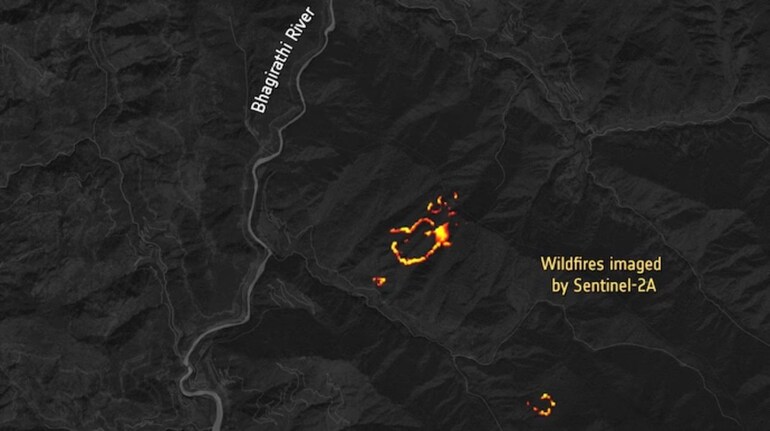

Satellite images released this week showed wildfires burning across Uttarakhand, captured from space by the Copernicus Sentinel-2 mission operated under the European Union’s Earth observation programme. The images highlighted active fire zones during ongoing dry weather conditions and offered authorities a clear view of the scale and spread of forest fires affecting the Himalayan state.
Sentinel-2 wildfire observation from space
The Copernicus Sentinel-2 mission recorded the fires using optical sensors. The satellite system has now crossed ten years of continuous operations. Sentinel-2A has remained in orbit since 2015. It was launched to capture detailed images of Earth’s surface. The mission focuses on changing landscapes and coastal regions. Data from Sentinel-2 supports agriculture, forestry, and water management activities.
Officials rely on these images to track environmental changes. Wildfire monitoring has become an important application of the data. The Uttarakhand imagery showed active fire fronts clearly. These observations help authorities understand fire behaviour patterns. Satellite coverage allows wide regions to be analysed quickly. Large forest areas can be viewed within a single pass.
Each Sentinel-2 satellite carries a 13-band multispectral optical instrument. The instrument functions like a highly advanced digital camera. It records sunlight reflected from land and atmosphere. This technology enables detection of smoke and burned areas. Images can cover swathes measuring up to 290 km. Such width allows monitoring of entire forest systems. The data helps estimate fire intensity and spread speed. Officials use these inputs for planning response measures.
Copernicus constellation and operational continuity
The Sentinel-2 mission operates using multiple satellites in orbit. Each satellite follows the same orbital path. They are positioned 180 degrees apart for efficiency. This configuration improves revisit frequency and coverage reliability. Sentinel-2B was added to the constellation during 2017. Sentinel-2C became operational during 2024, officials said. New satellites ensure data continuity as older units age. The mission remains fully automated and uncrewed. No astronauts are assigned to Sentinel-2 operations. Ground teams in Europe manage satellite control and data flow. Engineers oversee orbit stability and sensor performance. Scientists process imagery for environmental analysis.
What the data means for monitoring
Copernicus relies on Sentinel-2 for multiple monitoring services. The satellites support marine biological observations and methane tracking. They also contribute to specialised environmental assessments. Frequent high-resolution images feed the Copernicus Land Monitoring Service. Land managers receive updated information for resource oversight. Authorities use these datasets during environmental emergencies. Sentinel-2 coverage extends into polar and aquatic regions. This reach broadens scientific research across disciplines. The Uttarakhand wildfire images underline the mission’s continued relevance.
Discover the latest Business News, Sensex, and Nifty updates. Obtain Personal Finance insights, tax queries, and expert opinions on Moneycontrol or download the Moneycontrol App to stay updated!
Find the best of Al News in one place, specially curated for you every weekend.
Stay on top of the latest tech trends and biggest startup news.





