






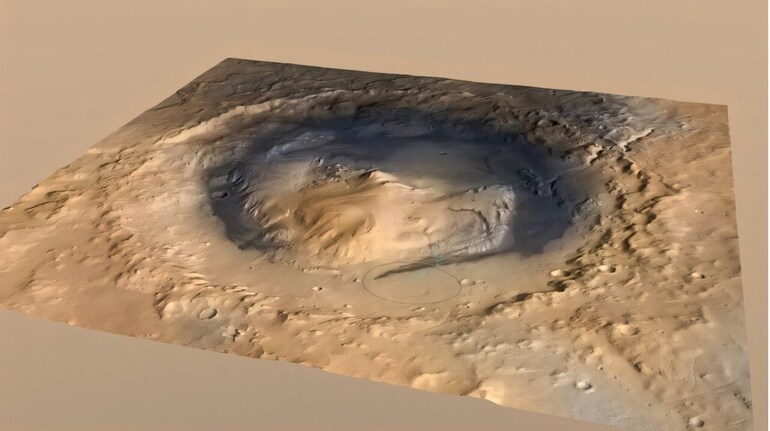

New images released by the European Space Agency reveal evidence of an ancient Martian ice age, offering fresh insight into how shifting climates once reshaped the Red Planet’s surface far beyond its polar regions.
Signs of an ancient Martian ice age
Earth’s harshest ice age occurred around 700 million years ago, carving valleys, fjords, and glacial landforms still visible today. Scientists now say Mars experienced similar frozen periods, leaving behind scars that still mark its dusty terrain. ESA recently shared images captured by the High Resolution Stereo Camera aboard its Mars Express spacecraft, highlighting features linked to past glaciation.
The pictures focus on a region showing long, roughly parallel grooves cutting diagonally across the landscape. These formations, known as Coloe Fossae, appear to have formed when sections of ground collapsed in alternating patterns, likely influenced by subsurface ice.
Beyond these grooves, ESA scientists identified several other glacial signatures across valleys and craters. Many impact craters show swirling surface textures, suggesting slow movement of ice-rich material long after the impacts occurred. These features point to a planet that once experienced repeated freezing and thawing cycles, reshaping its surface over extended periods.
What the glacial features reveal
Researchers describe Lineated Valley Fill as valleys packed with twisted, flowing patterns. These shapes indicate debris-covered ice moving gradually downslope. Concentric Crater Fill shows circular ridges within craters, formed as ice accumulated, compressed, and deformed over time.
Another striking feature, Lobate Debris Aprons, resembles rocky tongues spreading from slopes, hiding large volumes of ice beneath layers of debris. Together, these landforms suggest glaciers once behaved dynamically across Mars, much like those on Earth.
Notably, these features lie around 39 degrees north latitude, far from Mars’s present polar ice caps. This raised an obvious question about how ice reached such mid-latitude regions in the first place.
What happens next for Mars research
ESA explains that the answer lies in changes to Mars’s axial tilt. Over millions of years, shifts in the planet’s tilt drove dramatic climate swings. During colder phases, ice flowed outward from the poles toward lower latitudes. When conditions warmed, the ice retreated, leaving behind unmistakable geological traces. According to ESA, this Martian ice age may have occurred as recently as 500,000 years ago, making it relatively recent in planetary terms.
Scientists believe studying these features will help reconstruct Mars’s climate history and assess where ice may still be hidden today. Such knowledge could guide future robotic missions and, eventually, human exploration, as buried ice remains a vital resource on an otherwise dry planet.
Discover the latest Business News, Sensex, and Nifty updates. Obtain Personal Finance insights, tax queries, and expert opinions on Moneycontrol or download the Moneycontrol App to stay updated!
Find the best of Al News in one place, specially curated for you every weekend.
Stay on top of the latest tech trends and biggest startup news.





