






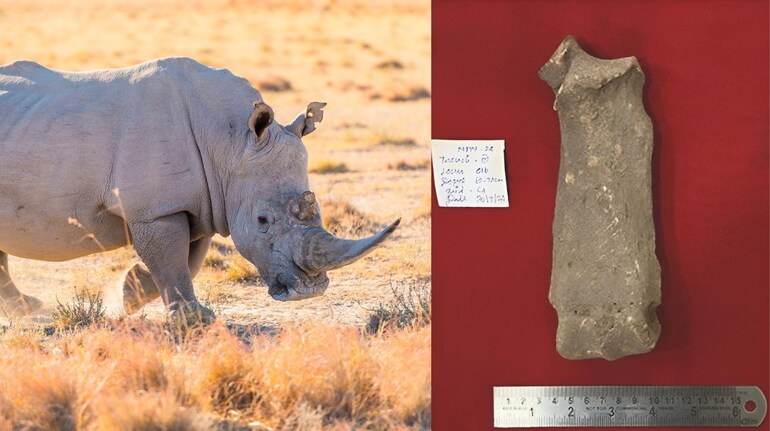

Archaeologists in Tamil Nadu have uncovered rare bone fragments belonging to a rhinoceros near Coimbatore. They revealed that this massive animal once roamed deep into southern India. Dating back nearly of 3,500 years, the fossils were found at a Neolithic site in the foothills of the Western Ghats. The discovery challenges long-held beliefs that rhinos were limited to northern and north-eastern India.
A Lost Giant of the South
Excavations near Coimbatore reveal prehistoric secrets. This site lies close to Western Ghats foothills rich ancient biodiversity. Researchers uncovered fragments while studying Neolithic era human settlements. These bones are preserved within layered soil revealing centuries of environmental changes.
Carbon dating confirms remains belong to period 3,500 years ago. Location once supported wetlands grasslands and slow flowing river systems. These habitats perfectly suited massive grazing mammals like rhinoceroses once.
How Rare Is This Discovery?
Rhino fossils rarely appear in southern India archaeological records. Most earlier discoveries came from Assam Bengal and Himalayan plains. Finding remains near Coimbatore shocked researchers and conservationists alike. Experts call it one of India’s rarest prehistoric wildlife discoveries. Very few similar samples exist in national museum collections today. This fragment opens a new chapter in Indian environmental history.
Archaeologists have unearthed Indian rhino bone fragments at a Neolithic site near Coimbatore, dating back 3,500 years, the third such discovery in South India. The finding reveals that long before they were confined to Assam’s grasslands, rhinos once roamed the Western Ghats 🙄… pic.twitter.com/PVLU4Hj5BI— Supriya Sahu IAS (@supriyasahuias) January 27, 2026
Tracing the Identity of Ancient Giants
Scientists suspect the Indian one horned rhinoceros species connection. However, weathering makes exact identification extremely difficult today. Bone thickness suggests adaptation to wetlands and open grasslands nearby. DNA testing may reveal hidden evolutionary relationships in future studies. Researchers compare fragments with museum specimens across Asia currently.
What This Means for Conservation Today?
Ancient disappearance warns about consequences of habitat destruction today. Climate change once pushed rhinos from southern landscapes gradually. Modern threats include poaching deforestation and shrinking protected areas. Study highlights importance of preserving wetlands and forest corridors.
Could Rhinos Ever Return to South India?
Rewilding experts discuss restoring ancient habitats in selected regions. However, population pressure limits space for large wild animals. Human settlements now cover most former grassland territories. Restoring wetlands would require massive political and financial commitment.
Discover the latest Business News, Sensex, and Nifty updates. Obtain Personal Finance insights, tax queries, and expert opinions on Moneycontrol or download the Moneycontrol App to stay updated!
Find the best of Al News in one place, specially curated for you every weekend.
Stay on top of the latest tech trends and biggest startup news.





