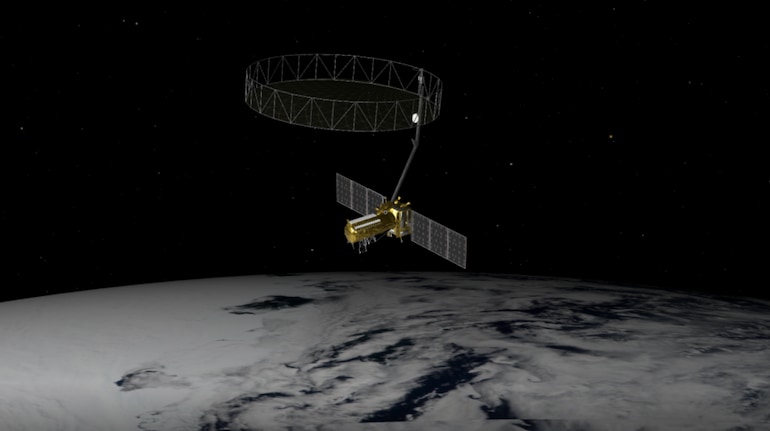
It feels like a long wait is finally ending. ISRO has begun the launch campaign for its historic partnership with NASA. The NASA-ISRO Synthetic Aperture Radar (NISAR) mission is expected to take flight this June, carrying one of the largest radar systems ever sent to space.
Countdown to June Launch
Work on the ambitious satellite is nearly complete. Both space agencies are currently reviewing potential launch dates in June. The GSLV’s second stage has been moved from the ISRO Propulsion Complex to Sriharikota’s launch site. The mission, named GSLV-F16, will soon lift off from here.
Meanwhile, the Space Applications Centre (SAC) in Ahmedabad, which led development of the S-band radar, is looking ahead. SAC has invited private start-ups to a workshop this week. The event aims to discover commercial uses of NISAR’s advanced technology and inspire new technical ventures.
A New Look at Earth’s Changing Face
NISAR has been nearly a decade in careful development. Scientists from India and the US worked tirelessly, even through Covid-19 disruptions. NASA created the L-band radar for long-range imaging. ISRO and SAC built the matching S-band radar for sharper results.
In March 2021, the S-band system travelled to NASA’s Jet Propulsion Laboratory. There, it was combined with the L-band radar into a single powerful payload. By March 2023, the integrated system arrived at the UR Rao Satellite Centre for final checks.
NISAR’s radars can see through clouds and work day or night. The satellite will scan almost the entire Earth every 12 days. It will track changes in land, ice, and sea surfaces in stunning detail.
ISRO says NISAR will offer free high-resolution data worldwide. It will monitor crops, forests, mangroves, soil moisture, glaciers, wet snow, and ocean winds. It can even detect earthquakes, landslides, and volcanic activity with precision.
The mission was originally due for early 2024. However, a technical issue required a part to be sent back to the US, causing the delay.
Busy Season Ahead for ISRO
Beyond NISAR, ISRO has a packed calendar this summer. The PSLV-C61 mission will soon launch, carrying the EOS-09 satellite. It features a C-band synthetic aperture radar to image Earth’s surface, rain or shine.
Also upcoming is the TV-D02 mission for Gaganyaan. This test flight will simulate an emergency abort and practice sea-recovery of the crew module. India’s first human spaceflight is inching closer, with a revised budget of Rs 20,193 crore.
Meanwhile, Chandrayaan-4 has been sanctioned with a cost of Rs 2,104 crore. Its goal is to collect soil samples from the Moon’s southern highlands by October 2027.
Looking further ahead, ISRO plans to build a Bhartiya Antariksh Station by 2035. It also dreams of placing an Indian astronaut on the Moon by 2040.
Discover the latest Business News, Sensex, and Nifty updates. Obtain Personal Finance insights, tax queries, and expert opinions on Moneycontrol or download the Moneycontrol App to stay updated!
Find the best of Al News in one place, specially curated for you every weekend.
Stay on top of the latest tech trends and biggest startup news.