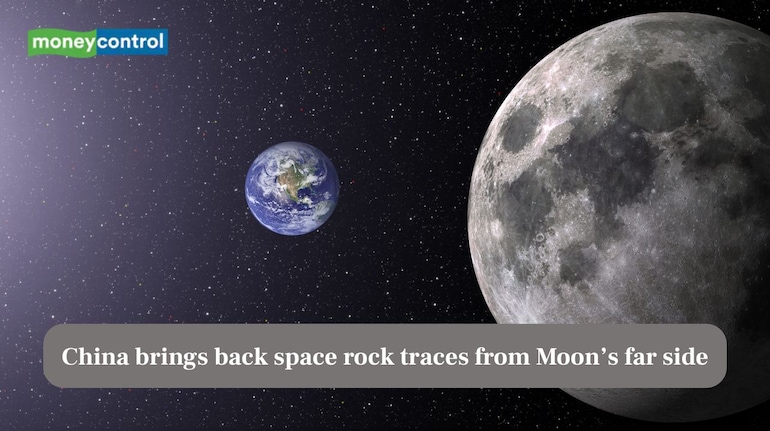
China’s Chang’e-6 mission has brought back a stunning surprise. Scientists found fragments of a rare meteorite type inside lunar soil. The samples were collected from the far side of the Moon. This area lies within the South Pole-Aitken Basin. This is one of the Solar System’s oldest craters.
Ancient Visitors Hidden in Dust
Researchers identified tiny particles known as CI chondrites. These are carbon-rich meteorites that are extremely fragile. Such meteorites rarely survive the Earth’s atmosphere. Scientists were shocked how these meteorites survived on the Moon.
The fragments had minerals such as olivine and unusual isotope patterns. These matched known CI chondrite signatures, proving they came from space.
Where is the Water's Origin?
CI chondrites have a lot of water and organic compounds. Their discovery suggests these materials once struck the Moon. This backs up the ideas that meteorites like these might have brought water to Earth. This clue provides a better sense of early chemistry of solar system.
The Moon: A Space Time Capsule
Unlike Earth, the Moon keeps ancient impacts safe. It lacks winds, weather or much geological change. This allows fragile space materials to remain untouched. Scientists now believe many meteorites could be buried in lunar dust.
Future Exploration
The find opens new directions for lunar research. China’s Chang’e-6 mission has changed how scientists view lunar history. Each grain of dust may hide secrets of birth of solar system. The findings also imply that the Moon’s surface may preserve a greater proportion of these meteorite types than Earth does.
Discover the latest Business News, Sensex, and Nifty updates. Obtain Personal Finance insights, tax queries, and expert opinions on Moneycontrol or download the Moneycontrol App to stay updated!
Find the best of Al News in one place, specially curated for you every weekend.
Stay on top of the latest tech trends and biggest startup news.