






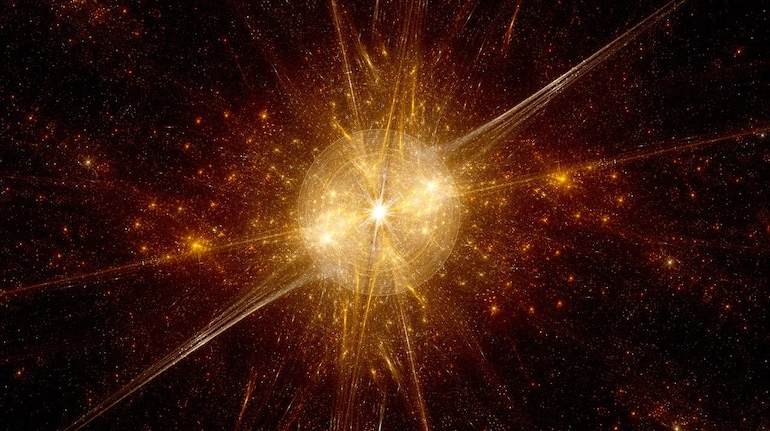
Scientists are revisiting the universe’s final destiny after new findings. The study comes from South Korean researchers analysing cosmic expansion. It suggests the universe may collapse rather than tear apart. The research focuses on dark energy losing strength. This shift could allow gravity to dominate cosmic behaviour. Such a change points towards a possible Big Crunch.
Dark energy shows signs of weakening
For decades, scientists believed expansion would continue forever. That view changed after discoveries made during 1998 observations. Astronomers then identified dark energy accelerating universal expansion. This force appeared powerful enough to overcome gravity permanently. The theory predicted a violent ending called the Big Rip. Atoms, stars, and galaxies would eventually be destroyed.
The new study challenges that long-held cosmic picture. Researchers reanalysed supernova data gathered nearly three decades ago. Those explosions originally revealed dark energy’s existence to scientists. Professor Young Wook Lee led the Yonsei University team. They adjusted earlier measurements using updated analytical models. Their results showed cosmic acceleration slowing gradually over time.
According to Lee, this alters the universe’s predicted fate. Dark energy appears less constant than previously assumed. As it weakens, gravity may regain cosmic control. This could pull galaxies back towards each other. The scenario makes a Big Crunch increasingly possible.
A Big Bang in reverse
Under this model, expansion would eventually stop completely. Gravity would then cause the universe to contract inward. This process mirrors the Big Bang, but reversed. Intergalactic matter would begin falling towards a central core. Stars and planets would be dragged into intense compression. Heat would rise as matter collapses under pressure.
A massive fireball would form at the universe’s centre. Space and time would gradually lose meaning entirely. All remaining matter would merge into extreme density. Nothing would remain outside this final burning core.
Professor Ofer Lahav commented on the study’s implications. He spoke to the BBC about dark energy variability. Fluctuating dark energy would challenge modern physical understanding. Such behaviour would force major changes in cosmology.
What this could look like from Earth
Despite interest, many scientists remain unconvinced by Lee’s theory. Most still support endless expansion driven by constant dark energy. Even so, earlier studies explored how a Big Crunch appears. From Earth, stars would seem increasingly closer together. Galaxies and clusters would slowly merge across the sky. Stellar collisions would become more frequent over time.
The cosmic microwave background would heat dramatically. Temperatures could reach thousands of degrees Celsius. Currently, this radiation sits just above absolute zero. These changes would unfold over immense cosmic timescales.
For now, the universe continues expanding outward. Whether it ends expanding or collapsing remains uncertain. The debate shows how much remains unknown.
Discover the latest Business News, Sensex, and Nifty updates. Obtain Personal Finance insights, tax queries, and expert opinions on Moneycontrol or download the Moneycontrol App to stay updated!
Find the best of Al News in one place, specially curated for you every weekend.
Stay on top of the latest tech trends and biggest startup news.




