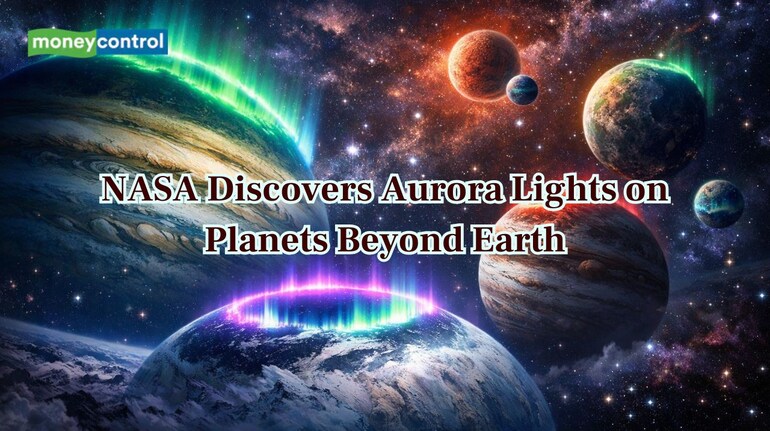

Auroras lights are the spectacular northern and southern lights. They are not unique to Earth. They are found on other planets too. NASA has discovered that these glowing light shows appear on several other planets. The findings come from space telescopes and planetary observations, revealing auroras on planets like Jupiter, Saturn, Uranus, Neptune, Mars, and Venus.
The Planets with Visible Auroras
1. Jupiter: Hosts the most intense auroras in the solar system, thanks to its enormous magnetic field. Hubble has captured images of Jupiter’s auroras in stunning detail.
2. Saturn: Shows auroral activity at its poles, glowing when solar wind particles collide with the planet’s magnetic field.
3. Uranus and Neptune: Both have auroras, although their unusual magnetic fields make the light displays irregular and sometimes difficult to observe.
4. Mars and Venus: Even without strong global magnetic fields, these planets display faint auroras in ultraviolet or visible light, caused by high-energy particle collisions with their atmospheres.
How Are Auroras Formed?
Auroras occur when charged particles from the Sun, known as the solar wind, collide with gases in a planet’s atmosphere. A planet’s magnetic field directs these particles toward the poles. When they hit atmospheric molecules, the gases become excited and emit light, creating the colourful glow we see as auroras.
Evolution of Auroras
Auroras have been observed on Earth for centuries starting with first scientific observations of auroras on Earth in 1600s. In 1970s, the spacecraft detect auroras on Jupiter, proving they exist beyond Earth.
Today, NASA and Hubble continue to study auroras across multiple planets, learning how magnetic fields, solar winds and atmospheres interact in different environments.
How Scientists Are Tracking Auroras?
Scientists use a combination of space telescopes, orbiting satellites and planetary probes to observe auroras across the solar system. NASA’s Hubble Space Telescope captures ultraviolet auroras on Jupiter and Saturn. Spacecrafts such as Juno and Cassini provide close-up observations of planetary auroras.
Discover the latest Business News, Sensex, and Nifty updates. Obtain Personal Finance insights, tax queries, and expert opinions on Moneycontrol or download the Moneycontrol App to stay updated!
Find the best of Al News in one place, specially curated for you every weekend.
Stay on top of the latest tech trends and biggest startup news.