








Astronomers have discovered a black hole that is defying the laws of physics, growing at 13 times the expected cosmic speed limit. The black hole is part of a distant quasar named ID830.
This existed roughly 12 billion years ago when the universe was still young. Despite its early age, it has already reached a mass about 440 million times that of the Sun.
A Cosmic Glutton Beyond the Eddington Limit
Normally, black holes cannot grow faster than the Eddington limit. Radiation from infalling matter pushes outward, preventing material from falling in too quickly.
But ID830 appears to be ignoring this rule, devouring gas and dust far faster than theoretical models allow. This suggests that either our understanding of black hole physics is incomplete or extraordinary conditions exist in the early universe.
The Team Behind the Discovery
This study was led by researchers using state-of-the-art telescopes and observatories worldwide. They combined optical, X-ray and radio observations. The team analysed light emitted from the quasar to measure its mass, energy output and growth rate.
The research provided the first detailed look at a black hole exceeding the long-accepted Eddington limit.
Unexpected Signals: X-Rays and Radio Jets
Adding to the mystery, ID830 emits both powerful X-rays and radio jets simultaneously. Scientists previously thought rapid black hole growth would suppress such jets.
This unusual combination makes the black hole a “rule-breaker” and challenges current models of early galaxy and black hole evolution.
How Scientists View This Cosmic Glutton?
For researchers, ID830 is a challenge to understand physics of black hole. Normally, radiation from infalling material limits how fast a black hole can grow. But this one appears to ignore that rule, absorbing gas and dust at unprecedented rates.
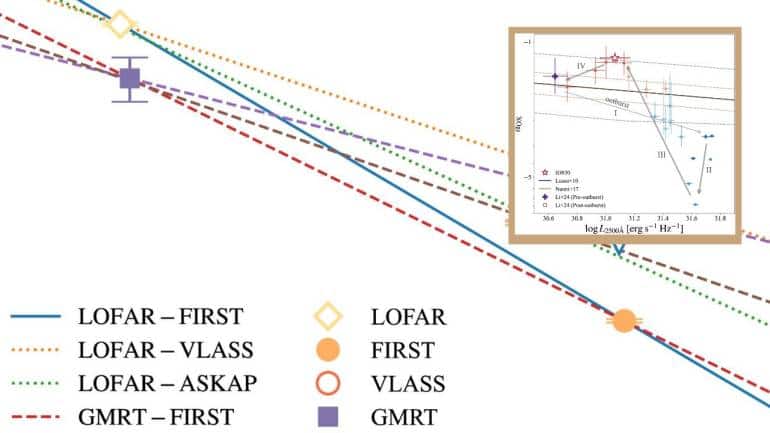 Radiation from infalling material limits how fast a black hole can grow. (Image: The Astrophysical Journal)
Astronomers call it a “rule-breaking” black hole, combining extreme mass with extraordinary growth, offering a rare laboratory to study the physics of the early universe.
What Makes This Black Hole So Bizarre?
ID830 is unusual for several reasons. It exceeds the Eddington limit by 13 times. This emits X-rays and powerful radio jets simultaneously. Such rays are not expected at rapid growth rates.
Its enormous mass formed surprisingly quickly, when the universe was less than 2 billion years old. This black hole is rewriting what scientists thought was physically possible.
Discover the latest Business News, Sensex, and Nifty updates. Obtain Personal Finance insights, tax queries, and expert opinions on Moneycontrol or download the Moneycontrol App to stay updated!
Find the best of Al News in one place, specially curated for you every weekend.
Stay on top of the latest tech trends and biggest startup news.





