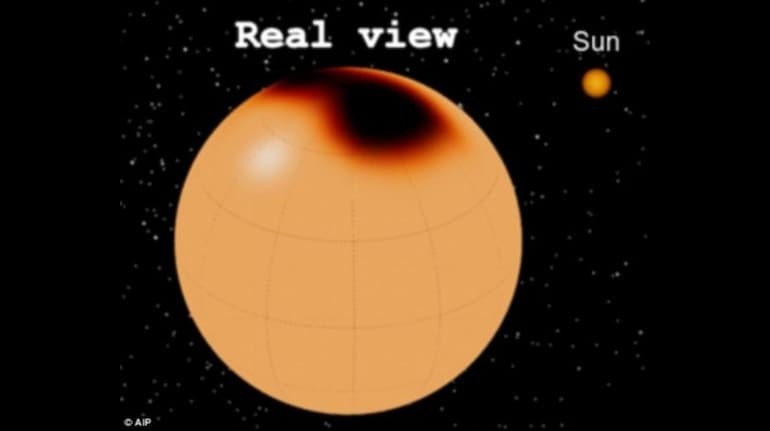
Astronomers have been tracking starspots on a red giant star, XX Trianguli, and their findings reveal unpredictable internal behaviour. Unlike the sun, this distant star’s surface activity doesn’t follow a regular cycle, suggesting chaotic processes within its core.
What Are Starspots and Why Do They Matter?
Starspots, much like sunspots, are dark patches caused by magnetic activity. They form when intense magnetic fields disrupt the surface, and their movement reveals clues about a star's interior. While sunspots follow an 11-year cycle, starspots can appear on different stars with unique patterns.
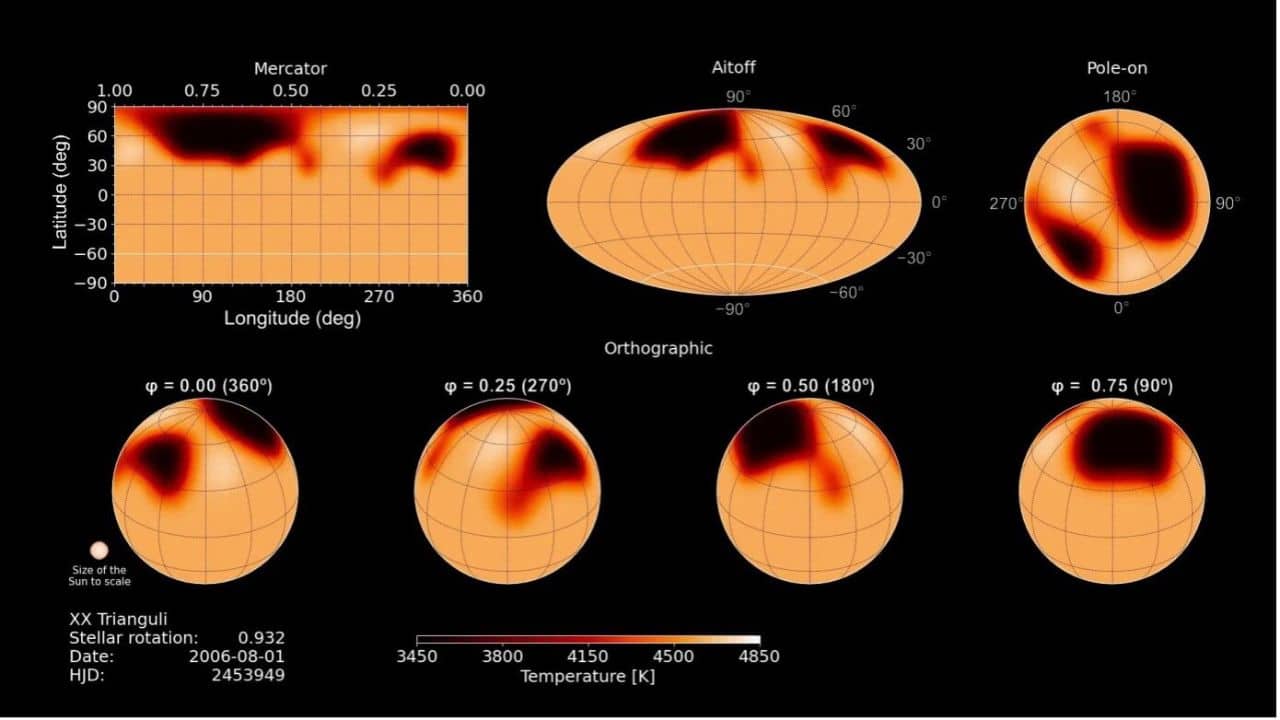 A snapshot from the movies displays the surface of XX Trianguli in four projection styles. The top row shows Mercator, Aitoff, and pole-on projections (left to right), while the bottom row presents spherical projections at four rotational phases, each separated by 90 degrees. Each movie runs for 3 minutes and is available in the publication. (Image: HUN-REN CSFK/Zs)
The sun’s activity, though sometimes intense, remains relatively predictable. This stability is crucial for life on Earth, as sunspot-related flares can disrupt technology. In contrast, XX Trianguli exhibits irregular starspot behaviour, pointing to a more chaotic dynamo — the internal movement of its magnetic materials.
What Makes XX Trianguli Unique?
XX Trianguli, located 630 light-years away, rotates once every 24 days. Researchers observed dramatic variations in its brightness caused by massive starspots. These spots are so large that they can displace the star’s apparent position in the sky.
For reference, the photocentre — the centre of light emitted — shifts away from these giant spots. In XX Trianguli’s case, it can move by up to 10% of the star’s radius. This causes a displacement of 24 micro-arcseconds, comparable to the width of a hair viewed from 1,000 kilometres.
Why Do Scientists Monitor Starspots?
Sunspots and starspots offer vital information about stellar interiors and magnetic fields. The irregular activity of XX Trianguli demonstrates that not all stars behave like our sun. Its chaotic dynamo disrupts magnetic cycles, offering astronomers a new perspective on stellar evolution.
Read Also: NASA’s Juno captures stunning close-up of Jupiter’s moon Io’s volcanic activity; see image here
Co-author Zsolt Kővári explained that XX Trianguli’s starspots are even larger than the sun’s surface. This extreme size earned it the title “the most spotted star in the sky.” Such studies are important for understanding magnetic activity across different types of stars.
A Small Shift with Big Implications
Though XX Trianguli’s photocentre shift may seem minor, these tiny displacements can have significant effects when measured over galactic distances. The study marks the first instance of this phenomenon being observed, highlighting the immense scale of stellar processes.
Published in Nature Communications on December 4, the findings emphasise how diverse starspot behaviour can be. While the chaotic nature of XX Trianguli’s activity fascinates researchers, it’s a reminder of the relative calm of our own sun. Its predictable cycle is something Earth can rely on — for now.
Discover the latest Business News, Sensex, and Nifty updates. Obtain Personal Finance insights, tax queries, and expert opinions on Moneycontrol or download the Moneycontrol App to stay updated!
Find the best of Al News in one place, specially curated for you every weekend.
Stay on top of the latest tech trends and biggest startup news.