






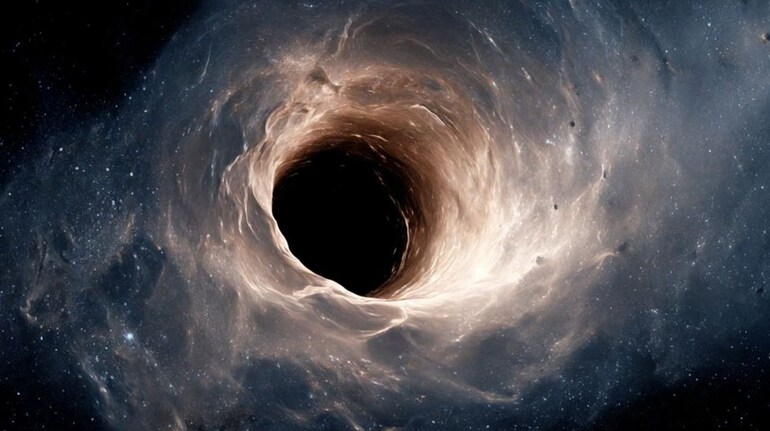

Astronomers have explained long puzzling flickers near black holes, researchers say. The findings describe rhythmic signals seen in high energy radiation. These signals are known as quasi periodic oscillations. Scientists have studied them for several decades.
The research uses advanced numerical simulations of black hole systems. It focuses on matter moving extremely close to black holes. Black holes themselves cannot be directly observed by telescopes. Scientists instead study radiation from surrounding accretion discs.
These discs form when matter spirals inward under gravity. Rotational motion inside discs produces mostly thermal radiation. Faster inward motion changes the radiation properties significantly. This produces non thermal signals seen as flickers.
The oscillations appear as repeating beats in observed light. Their frequencies range from below one hertz upward. Heavier black holes generally show slower oscillation patterns. Lighter systems produce faster rhythmic flickers.
How accretion discs create black hole flickers
The study was conducted by scientists from ARIES. Researchers from MJPRU Bareilly also participated in analysis. International partners included institutes in Poland and France. Together they modelled accretion flows using two dimensional simulations.
The simulations used a relativistic equation of state. They tracked viscous flows of matter over time. Results showed gas does not fall smoothly inward. Instead the flow forms shock regions within the disc.
These shocks slow down and heat the infalling gas. Density increases sharply within these shock zones. The behaviour resembles shock waves in supersonic jets. Cooling through radiation plays a key role.
When viscosity reaches specific levels, shocks become unstable. The study identified viscosity values above alpha zero point zero five. Under these conditions, shocks begin oscillating regularly. These oscillations produce the observed flickering radiation patterns.
Why shocks and turbulence matter near black holes
The simulations also revealed turbulent bubble like regions. These formed behind the oscillating shock fronts. The regions moved and expanded within the inner disc. Their motion influenced radiation output over time.
In some cases, the turbulent regions erupted outward. These eruptions formed bipolar jets or outflows. The jets moved perpendicular to the accretion disc plane. Under high viscosity, speeds exceeded twenty five percent light speed.
Researchers analysed density, temperature and angular momentum changes. These measurements matched observed radiation variations closely. The results linked disc behaviour directly with flicker patterns. This provided a physical explanation for QPO signals.
What the findings mean for black hole research
The team said this simulation approach is unique. It models viscous transonic flows using realistic plasma physics. The plasma consisted of electrons and protons. Previous models lacked this level of physical detail.
The findings explain low frequency QPOs around stellar black holes. The oscillations arise from fluid behaviour within discs. They do not require solid or rigid structures. This resolves a long standing scientific question.
By matching simulations with astronomical observations, the study advances understanding. It clarifies how extreme environments behave near black holes. Scientists say future models may extend to other systems. The work offers clearer insight into high energy cosmic processes.
Discover the latest Business News, Sensex, and Nifty updates. Obtain Personal Finance insights, tax queries, and expert opinions on Moneycontrol or download the Moneycontrol App to stay updated!
Find the best of Al News in one place, specially curated for you every weekend.
Stay on top of the latest tech trends and biggest startup news.





