






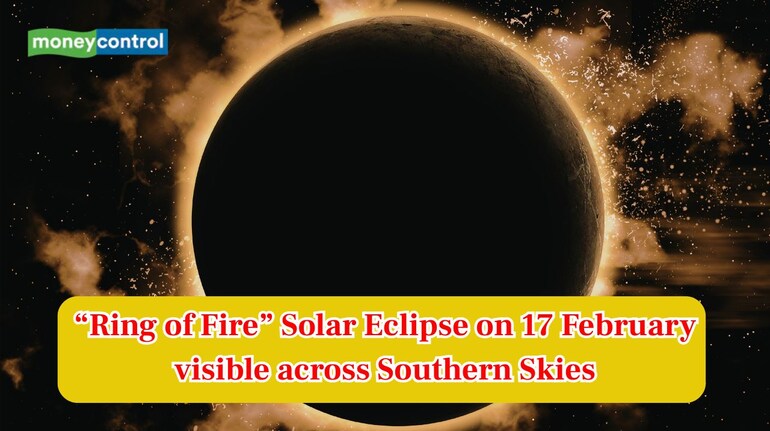

A rare annular solar eclipse, commonly known as a Ring of Fire is scheduled for Tuesday, 17 February 2026. In this celestial event, the Moon will pass directly between Earth and the Sun. Because it is near its farthest point from Earth, it will not block the Sun completely. Instead, the Sun’s outer edge will remain visible, forming a glowing ring of light around the Moon’s silhouette.
What Exactly is an Annular Eclipse?
Unlike a total solar eclipse, an annular eclipse occurs when the Moon is slightly farther from Earth in its elliptical orbit. This distance makes the Moon appear smaller in the sky, unable to completely cover the Sun. The result is a glowing ring of sunlight that surrounds the Moon.
Astronomers call this effect as the “Ring of Fire.” Eclipses like this combine precise celestial mechanics with visual spectacle. They offer scientists a chance to study the Sun’s corona and solar atmosphere in unique ways.
Where Will the Eclipse Be Visible?
The annular eclipse will be visible primarily across parts of Southern Africa, Australia and the Pacific region. Countries including Namibia, Botswana, South Africa and Australia will witness the full annular phase. The other regions will see a partial solar eclipse.
Observers in major cities along the path of annularity will experience the perfect “Ring of Fire” effect, while those outside the central path will see a partial eclipse, with the Moon covering only part of the Sun.
Antarctica will see this Eclipse Clearly
Antarctica offers one of the best vantage points for observing this eclipse. The full annular phase will be visible across wide regions. The continent will be able to observe the “Ring of Fire” without obstruction. The eclipse is expected to occur between 09:00 to 12:00 UTC. Due to minimal light pollution and clear southern skies, Antarctica provides an exceptional opportunity.
What timings would be perfect to see the Eclipse?
The eclipse will begin at 07:01 UTC on 17 February. The maximum phase will be seen over Antarctica. The annular phase will last up to 2 minutes and 20 seconds. The path of annularity will be narrow and remote.
It will stretch up to 472 miles, or 759 kilometres, wide. Scientists recommend using certified solar viewing glasses, pinhole projectors, or indirect viewing techniques to enjoy the event safely.
Discover the latest Business News, Sensex, and Nifty updates. Obtain Personal Finance insights, tax queries, and expert opinions on Moneycontrol or download the Moneycontrol App to stay updated!
Find the best of Al News in one place, specially curated for you every weekend.
Stay on top of the latest tech trends and biggest startup news.





