






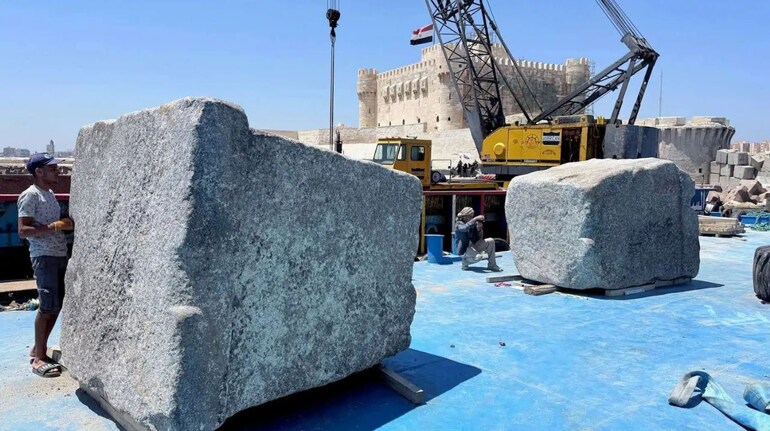

Archaeologists have made a remarkable discovery in Egypt’s Eastern Harbour. Massive stone blocks from the legendary Lighthouse of Alexandria, one of the Seven Wonders of the Ancient World have emerged from the sea after 1,600 years underwater. The find offers an unprecedented glimpse into the architecture, engineering and history of this Hellenistic marvel.
What the 27-Metre-Tall Lighthouse Once Was?
The lighthouse was built during the early Hellenistic period, shortly after Alexander the Great founded the city. For centuries, it guided ships safely into Alexandria’s busy harbour. Rising perhaps up to 140 metres, it was one of the tallest man-made structures of the ancient world. Repeated earthquakes eventually destroyed it.
Over time, its remains sank to the harbour floor, buried in sand and water. Now, after more than a millennium and a half, researchers are finally recovering and analysing its stones.
The Recovery: Mapping and Lifting Giant Blocks
The recovered materials include enormous granite and limestone blocks, some weighing up to 170,000 pounds (77,000 kg). Among them are pieces of the main entrance doorway, providing critical clues to the lighthouse’s layout.
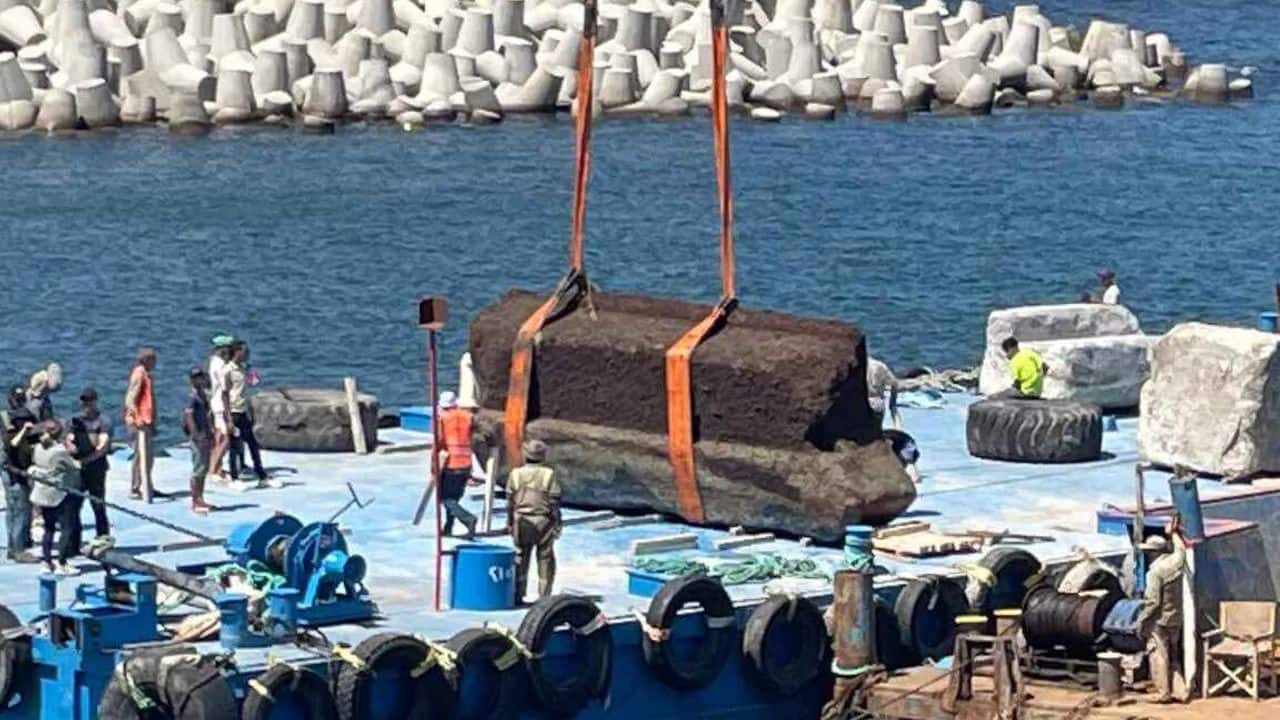 Some pieces of lighthouse weigh up to 170,000 pounds (77,000 kg). (Image: GEDEON Programmes / CEAlex)
Archaeologists spent years mapping thousands of fragments on the seabed before attempting to lift them. Once lifted, the stones were photographed and scanned using photogrammetry, a technique that combines multiple images to build detailed 3D models.
Digital Reconstruction will help Scienctists to Learn More
The photogrammetry scans are used to create a “digital twin”. This is a virtual model of the lighthouse. This model helps researchers test hypotheses about its original design, stability, and eventual collapse.
It also provides insight into ancient Hellenistic engineering techniques, such as how large stones were fitted together and how the structure could reach such remarkable heights.
Brilliant Mind Behind this Discovery
The project is led by Isabelle Hairy, an archaeologist and architect with France’s National Centre for Scientific Research (CNRS). A team of specialists from multiple countries collaborates on excavation, scanning and modelling.
Their work combines archaeology, architecture and digital technology to recreate one of the ancient world’s most iconic landmarks.
The Lighthouse Legacy: Connecting Past and Present
The Lighthouse of Alexandria was not just a navigational aid. It was a symbol of human ingenuity. It combined architecture, engineering and maritime science, guiding sailors safely for centuries.
Today, the recovered blocks and digital twin allow researchers and the public to experience the monument virtually, connecting modern science with ancient history. It highlights how digital archaeology and photogrammetry can preserve heritage.
Discover the latest Business News, Sensex, and Nifty updates. Obtain Personal Finance insights, tax queries, and expert opinions on Moneycontrol or download the Moneycontrol App to stay updated!
Find the best of Al News in one place, specially curated for you every weekend.
Stay on top of the latest tech trends and biggest startup news.





