






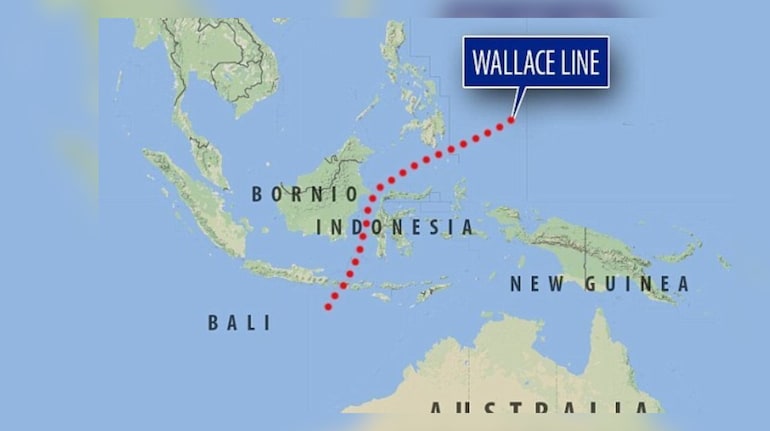

Scientists report fresh evidence explaining the Wallace Line, a famous biological boundary dividing Asian and Australian wildlife, using advanced climate and tectonic modelling published in Science.
For more than a century, this invisible line puzzled biologists worldwide. It separates neighbouring islands with strikingly different animals. Monkeys thrive west, while marsupials dominate just east. The mystery began with Alfred Russel Wallace observations. He travelled the Malay Archipelago during the 19th century. Wallace expected gradual ecological change between nearby islands. Instead, he recorded abrupt biological shifts across narrow seas. His findings shaped biogeography as a scientific discipline.
What shaped the Wallace Line boundary
New research suggests tectonic collision shaped this enduring divide. Australia drifted north after separating from Antarctica long ago. It eventually collided with the Eurasian continental margin. This collision formed Indonesia’s complex island chains. Deep ocean trenches persisted between emerging landmasses. These trenches blocked many land animals from crossing.
At the same time, Earth’s climate changed dramatically. Global cooling followed the isolation of Antarctica. Ice sheets expanded and rainfall patterns shifted worldwide. Tropical forests spread across parts of Southeast Asia. Australian species evolved under cooler, drier conditions. These contrasting histories influenced which animals could migrate.
Researchers from Australian National University and ETH Zurich tested this idea. They used a large computer simulation called Gen3SIS. The model tracked more than 20,000 vertebrate species. It combined fossil climates with shifting continental positions. The results showed uneven species exchange across the line. Asian animals crossed eastward more successfully overall. Australian species struggled moving west into humid forests.
Why climate favoured Asian species movement
According to the model, rainfall tolerance proved crucial. Asian species evolved within warm, wet tropical environments. They easily adapted to similar conditions further east. Australian fauna faced ecological barriers within dense rainforests. These forests acted as environmental filters against dry adapted species.
Lead author Dr Alex Skeels explained the contrast clearly. Asian animals were comfortable within Indonesia’s tropical islands. Australian animals were not similarly prepared for humidity. As a result, migration remained largely one directional.
What the findings could mean next
The study also sheds light on future biodiversity risks. Scientists say ancient climate responses mirror modern challenges. Understanding past adaptation may guide conservation planning today. The Wallace Line remains one of several global boundaries. Others include Weber’s Line and Lydekker’s Line nearby. Each highlights how geology shapes life’s distribution.
As climate change accelerates, such lessons grow urgent. Invisible lines may again decide which species survive.
Discover the latest Business News, Sensex, and Nifty updates. Obtain Personal Finance insights, tax queries, and expert opinions on Moneycontrol or download the Moneycontrol App to stay updated!
Find the best of Al News in one place, specially curated for you every weekend.
Stay on top of the latest tech trends and biggest startup news.





