






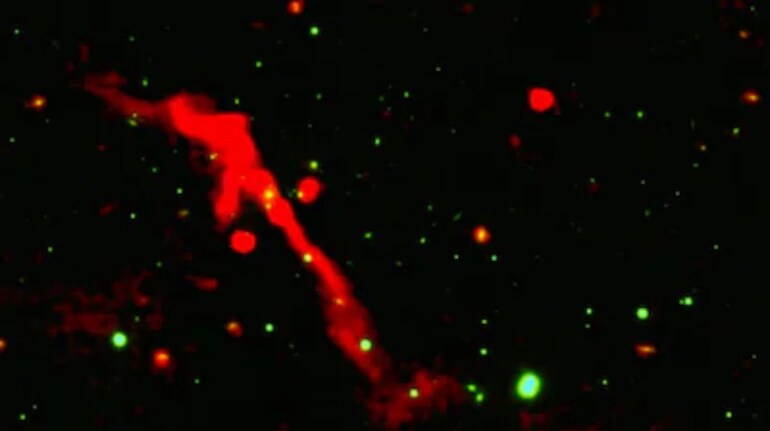

Astronomers have observed a long-silent black hole suddenly reactivating. The event was detected in the distant radio galaxy J1007+3540. After roughly 100 million inactive years, the black hole erupted again. Scientists compared the change to a cosmic volcanic eruption. The discovery was made using sensitive radio observations. India’s upgraded Giant Metrewave Radio Telescope played a key role. The finding shows black holes can restart unexpectedly after long quiet periods.
Researchers observed powerful plasma jets blasting from the galaxy’s core. These jets stretch across millions of light years. Their size has formed a striking new structure in space. Most galaxies host supermassive black holes at centres. However, only a small number actively launch plasma jets. J1007+3540 stands out for showing renewed activity. The observation suggests black hole behaviour is not permanent.
Radio evidence reveals dramatic black hole reactivation
The reawakening was identified through detailed radio imaging. Scientists detected bright emissions where none existed before. Lead researcher Shobha Kumari described the event as rebirth. Old, faded plasma surrounds the newly formed jets. This material likely comes from earlier active phases. The pattern suggests cycles of activity and dormancy. The black hole appears to switch on repeatedly. Such behaviour challenges simple models of galactic evolution.
A vast ring of ancient plasma encircles the galaxy. This ring hints at powerful eruptions millions of years ago. The new jets are cutting through this older material. Radio images show strong contrasts between old and new particles. These details helped confirm renewed black hole activity. The structure provides a timeline of past outbursts.
Galaxy cluster environment shapes powerful plasma jets
J1007+3540 sits inside a dense galaxy cluster. Hot gases create intense external pressure there. As jets push outward, surrounding gases resist strongly. Radio images show jets bent and compressed. The northern jet appears sharply curved. Scientists say external pressure forced plasma sideways. A long faded tail extends towards the southwest. This tail likely contains ancient magnetic plasma.
The interaction shows how environments influence black hole behaviour. Space evolution appears violent and constantly changing. Black hole power competes with surrounding cosmic conditions. The study used data from LOFAR in the Netherlands. India’s uGMRT provided crucial high sensitivity images. Scientists from Indian institutions collaborated internationally. The radio spectrum revealed extremely old particles compressed again.
Researchers say the system offers valuable scientific insights. It helps explain how black holes regulate galaxies. Further observations are planned to study jet expansion. J1007+3540 may help answer long standing cosmic questions.
Discover the latest Business News, Sensex, and Nifty updates. Obtain Personal Finance insights, tax queries, and expert opinions on Moneycontrol or download the Moneycontrol App to stay updated!
Find the best of Al News in one place, specially curated for you every weekend.
Stay on top of the latest tech trends and biggest startup news.





