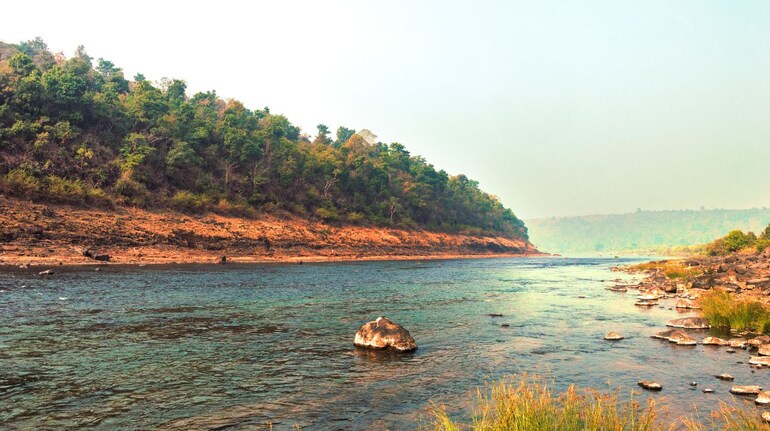

India’s river geography is often described as predictable and orderly. Most major rivers rise in the Himalayas or central highlands and flow eastward toward the Bay of Bengal. One river, however, quietly defies this familiar pattern. The Narmada flows west across the Indian subcontinent, shaped by geology rather than convention. Its unusual course continues to draw attention from geographers, historians, and local communities. The river’s direction challenges early textbook lessons while highlighting how landforms guide natural systems across centuries.
The river that flows west instead of east
The Narmada is the river that flows west instead of east. Stretching about 1,310 kilometres, it ranks as India’s fifth longest river. Unlike rivers such as the Ganga or Godavari, it does not empty into the Bay of Bengal. From its source, it follows a steady westward path before reaching the Arabian Sea. Only a few major Indian rivers share this direction, including the Tapi. The idea of the river flowing “backwards” exists only because most Indian rivers flow east. Experts note the river simply follows the natural slope of land.
Origin and geological reason behind the westward flow
The Narmada begins near Amarkantak in Madhya Pradesh. The forested region is also an important pilgrimage site. From here, the river travels west through Madhya Pradesh, briefly crosses Maharashtra, and then enters Gujarat. Its journey ends near Bharuch at the Arabian Sea. Geologists explain the direction is controlled by a rift valley formed by ancient tectonic activity. The valley slopes from east to west. Water naturally follows this gradient. The Vindhya Range lies north of the river basin. The Satpura Range lies to the south. Passing between these ranges, the river forms an estuary instead of a wide delta.
Landscapes, dams and cultural significance
The Narmada basin supports varied landscapes and communities. Upper stretches remain hilly, forested, and sparsely populated. Further west, the terrain becomes flatter and fertile. Agriculture here depends heavily on river water. Wheat, cotton, and pulses are widely grown. Towns and cities rely on the river for drinking water. Several large dams regulate its flow. The Sardar Sarovar Dam is the most prominent. Others include the Indira Sagar and Omkareshwar dams. These projects provide electricity and irrigation but have sparked debates over displacement and environmental impact.
The river is also linked to striking natural sites. Marble Rocks near Jabalpur rise sharply along its banks. Dhuandhar Falls thunder nearby during monsoon months. Beyond geography, the Narmada holds deep spiritual meaning. Pilgrims visit Amarkantak, Omkareshwar, and Maheshwar throughout the year. Some undertake the Narmada Parikrama pilgrimage. For many, the river is viewed as a living presence. Its westward journey has remained constant across generations, shaped by earth, faith, and time.
Discover the latest Business News, Sensex, and Nifty updates. Obtain Personal Finance insights, tax queries, and expert opinions on Moneycontrol or download the Moneycontrol App to stay updated!
Find the best of Al News in one place, specially curated for you every weekend.
Stay on top of the latest tech trends and biggest startup news.