
If you’ve glanced up at the night sky recently and noticed a faint new star, you’re not alone. Astronomers have confirmed a rare stellar explosion that’s become just visible to the naked eye — a fleeting celestial event lighting up the Lupus constellation.
A New Star is Born – Briefly
The nova, now officially named V462 Lupi, was first detected on 12 June by astronomers from Ohio State University's All-Sky Automated Survey for Supernovae. At the time, it held an apparent magnitude of +8.7 — still too dim for unaided eyes.
Within days, the object brightened quickly. It was initially tagged with several temporary names, including AT 2025nlr and ASASSN-25cm, while researchers rushed to confirm what they were seeing. Yusuke Tampo, an astronomer at the South African Astronomical Observatory, studied the object’s light and identified it as a classical nova — a powerful yet temporary explosion on a white dwarf star’s surface.
By 16 June, the star was officially named V462 Lupi. Just two days later, it reached a magnitude of +5.7, nudging it into the range of human visibility without any telescope.
A Stellar Flash in Lupus
V462 Lupi now shines roughly 4 million times brighter than its faint predecessor. It sits in the Lupus constellation, which stretches across the southern sky, making it easiest to see from the Southern Hemisphere.
But lucky skywatchers in North America have also caught glimpses of it. Observers from California, Arizona, and even as far north as Lake Superior have reported sightings shortly after sunset near the southern horizon.
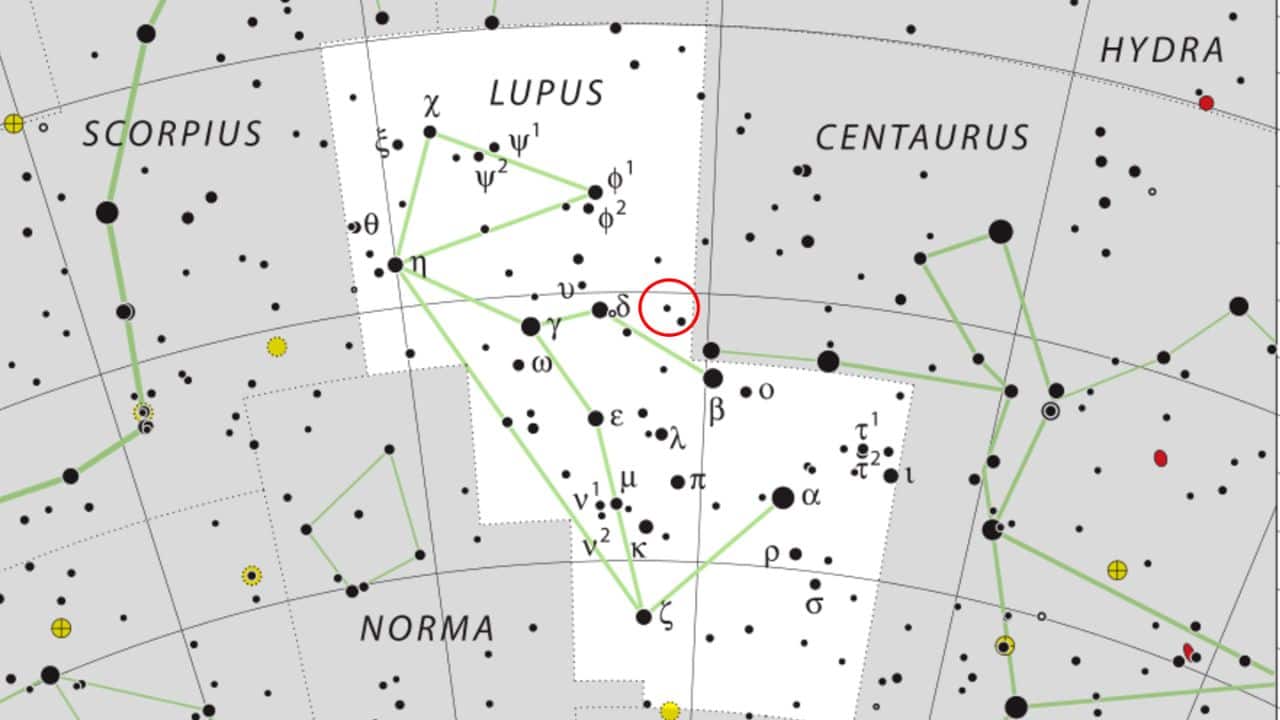 V462 Lupi sits within the Lupus constellation, marked roughly inside the red circle on this chart. (Image: Wikimedia)
Though you might spot it with the naked eye, a decent telescope or binoculars will improve your chances — especially from northern locations or if the nova begins to fade again.
Not a Supernova, But Still Spectacular
Classical novae are different from supernovae. They don’t destroy stars but only impact their outer layers. V462 Lupi likely comes from a binary system, where a dense white dwarf star pulls gas from a larger companion. Once enough material builds up, a flash of energy erupts, sending light racing across space to reach our skies.
Naked-eye novae are a rare treat. Experts say we typically see only one per year, and even then, many are barely visible. Some, like T Coronae Borealis — the famed “Blaze Star” — explode every few decades. That one has kept astronomers guessing for over a year now, as it still hasn’t reappeared despite predictions.
Since V462 Lupi is a first-time visitor, no one knows when or if it will return. For now, it's a rare moment of cosmic wonder — a reminder that the universe still has plenty of surprises.
Discover the latest Business News, Sensex, and Nifty updates. Obtain Personal Finance insights, tax queries, and expert opinions on Moneycontrol or download the Moneycontrol App to stay updated!
Find the best of Al News in one place, specially curated for you every weekend.
Stay on top of the latest tech trends and biggest startup news.