






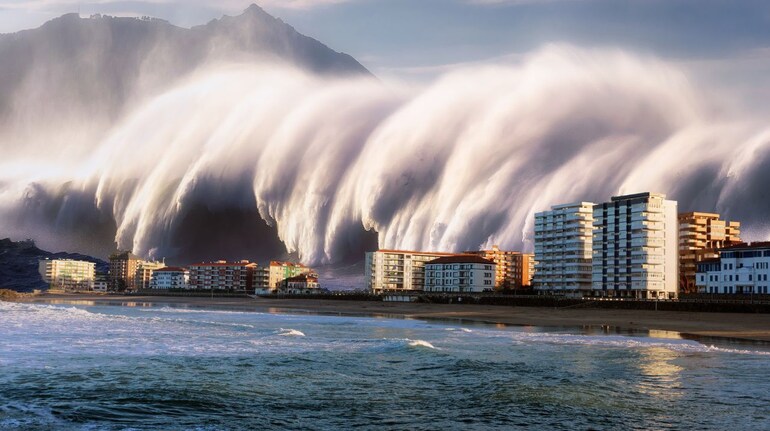

A mysterious global seismic pulse lasting nine days in September 2023 has been traced to a massive landslide and tsunami in Greenland’s Dickson Fjord, scientists said, after instruments worldwide detected an unusual rhythmic tremor.
Seismic stations recorded a steady repeating signal. The pulse returned every 92 seconds. It continued for nine full days. The vibration felt too weak for people. Yet it rattled bedrock across continents. Researchers ruled out a typical earthquake. Focus quickly shifted towards eastern Greenland.
Satellite images revealed a fresh mountainside scar. A vast slope had collapsed suddenly. On 16 September 2023, rock failed. More than 25 million cubic yards fell. Ice and stone plunged into narrow waters. The impact displaced enormous water volumes.
Landslide and Mega Tsunami at Dickson Fjord
The collapse triggered a towering mega tsunami. Waves rose to nearly 650 feet. Water surged along the two mile fjord. It damaged equipment on Ella Island. Losses reached about 200,000 dollars. After the first surge, motion persisted. The fjord rocked from side to side. This oscillation is known as a seiche.
Computer simulations recreated the prolonged sloshing. Surface levels rose and fell rhythmically. Some models suggested 8½ feet. Others estimated between 23 and 30 feet. Variations reflected different fjord assumptions. Both confirmed the landslide source.
 A Dickson Fjord location in East Greenland highlighted in a Copernicus Sentinel-2 satellite image showing where the mega-tsunami struck. (Image: ESA/Thomas Monahan)
Seismic Pulse and Global Investigation
Seismographs usually show jagged earthquake traces. This time, lines formed smooth peaks. The pattern barely weakened over days. More than 70 researchers joined efforts. They represented 41 institutions internationally.
Kristian Svennevig described early scientific confusion. Alice Gabriel highlighted modelling complexities. Robert Anthony of the United States Geological Survey praised global collaboration. Carl Ebeling noted unanswered scientific questions remain.
Field teams measured fresh cliff gouges. Supercomputers reconstructed avalanche dynamics precisely. Interdisciplinary work gradually solved the mystery.
 A Copernicus Sentinel-2 image of Dickson Fjord in East Greenland following the mega-tsunami, overlaid with sea-surface height data captured on 11 October by the Surface Water and Ocean Topography mission, revealing the scale of the Earth-shaking wave. (Image: ESA/Thomas Monahan)
Climate Change, Satellite Data and Future Risks
Scientists linked slope failure to warming trends. Retreating glaciers once stabilised the mountainside. Similar collapse struck Karrat Fjord during 2017. That tsunami destroyed homes and killed four. Dickson Fjord lies near cruise routes. Authorities are reviewing improved warning systems.
New satellite missions refined the analysis. The Surface Water and Ocean Topography mission mapped wide ocean swaths precisely. Thomas Monahan and Thomas Adcock explained benefits. Advanced data improves extreme event monitoring.
The full study was published in Science and Nature Communications. Researchers continue scanning seismic archives globally. Similar signals may reveal hidden disasters. Even remote Arctic regions demand vigilance.
Discover the latest Business News, Sensex, and Nifty updates. Obtain Personal Finance insights, tax queries, and expert opinions on Moneycontrol or download the Moneycontrol App to stay updated!
Find the best of Al News in one place, specially curated for you every weekend.
Stay on top of the latest tech trends and biggest startup news.





