






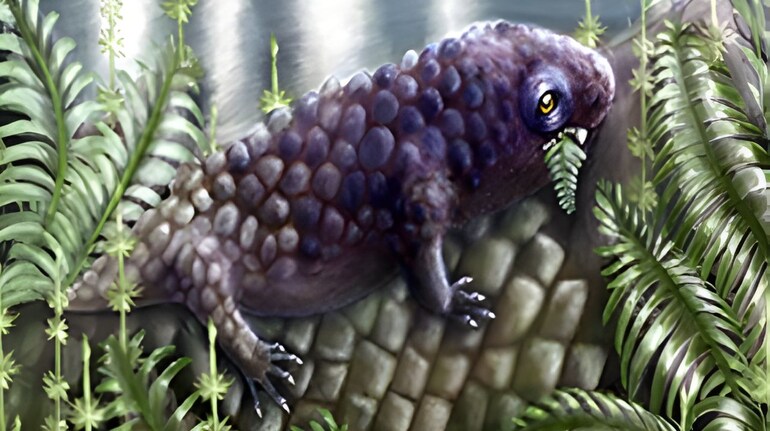

A tiny creature, smaller than a football, is rewriting the understanding of early land life. Tyrannoroter heberti, a 307-million-year-old tetrapod whose fossilised skull reveals one astonishing secret that it dined on plants.
Until now, scientists believed plant-eating on land evolved later. This discovery suggests herbivory began far earlier than imagined and among animals once thought to be strictly carnivorous or insectivorous.
What Did the Fossil Reveal?
The fossil, preserved with remarkable detail, shows broad, conical teeth perfectly suited for shearing and grinding tough vegetation. Unlike sharp, pointed teeth adapted for insects or meat, Tyrannoroter’s dentition signals a shift in diet. From a strictly carnivorous menu to one that included leaves, stems and possibly seeds.
At roughly the size of a modern football, the animal belonged to a primitive tetrapod group. Its skeletal structure indicates it was well-adapted for life on land yet retained traits reminiscent of its aquatic ancestors.
Where and When Did It Live?
Tyrannoroter heberti roamed the planet during the Late Carboniferous, roughly 307 million years ago. This era was dominated by towering forests and sprawling swamps. These lush environments would have provided plenty of vegetation for a pioneering herbivore.
The discovery adds a new layer to the understanding of early terrestrial ecosystems. Small tetrapods were not just opportunistic predators but also were already experimenting with plants, shaping food webs in ways we are only beginning to understand.
Who is behind this study?
Paleontologist Arjan Mann of the University of Toronto recognized the creature as a member of the Pantylidae family the moment he caught sight of it. Their painstaking analysis of fossilised skulls revealed teeth unlike any other early tetrapod.
It is broad, conical and perfectly adapted for munching on plants. Through CT scanning and comparative anatomy, the team was able to reconstruct the animal’s jaw mechanics, confirming that it was herbivorous.
How This Study Changed Modern Science?
Before Tyrannoroter heberti, scientists believed that plant-eating on land evolved later, after early tetrapods primarily fed on insects or smaller animals. This discovery rewrites that timeline.
It shows that herbivory emerged much earlier than expected, even in small tetrapods, suggesting that multiple lineages independently began experimenting with plants soon after vertebrates first colonised land.
Humans Got “Salads” from This Animal
While Tyrannoroter heberti itself is long extinct, its dietary habits paved the way for a chain reaction in evolution. By introducing herbivory on land, it helped plants become a stable, accessible food source.
Over millions of years, plant-eating animals diversified, eventually leading to the ecosystems that made salads, possible for humans. In a sense, this tiny Carboniferous creature sowed the seeds for humanity’s plant-based meals.
Discover the latest Business News, Sensex, and Nifty updates. Obtain Personal Finance insights, tax queries, and expert opinions on Moneycontrol or download the Moneycontrol App to stay updated!
Find the best of Al News in one place, specially curated for you every weekend.
Stay on top of the latest tech trends and biggest startup news.





