






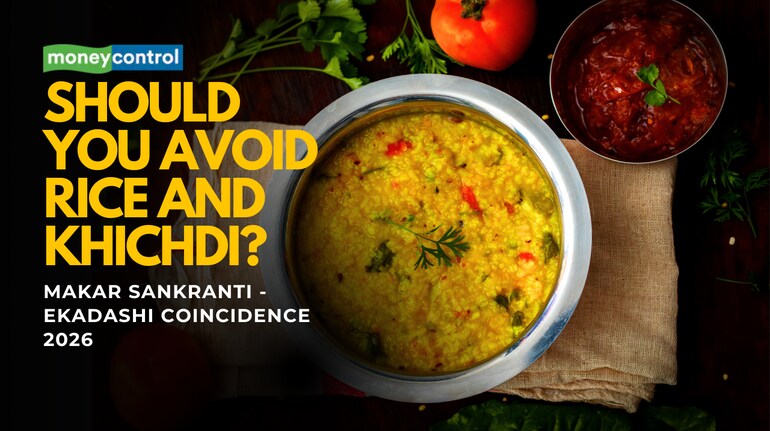

Makar Sankranti 2026 brings a rare and highly auspicious coincidence, as the festival will be observed along with Shattila Ekadashi after a gap of nearly 23 years. This special alignment has raised an important question among devotees: Can khichdi be cooked or rice donated on Makar Sankranti when Ekadashi falls on the same day? Here is a clear, scripture-based explanation of the religious rules and traditions to follow.
Makar Sankranti and Shattila Ekadashi 2026 Date
In 2026, Makar Sankranti will be celebrated on 14 January, the day when the Sun transits from Sagittarius to Capricorn. This marks the beginning of Uttarayan, considered the most auspicious phase in Hindu tradition. Coinciding with this is Shattila Ekadashi, a sacred fasting day dedicated to Lord Vishnu.
This rare overlap last occurred in 2003, making the 2026 coincidence especially significant. Devotees believe that worship, charity, and spiritual practices performed on this day bring multiplied results, as blessings of both Surya Dev and Lord Vishnu are received together.
Is Rice and Khichdi allowed on Ekadashi?
According to Hindu scriptures and learned priests, consumption and donation of rice and grains are strictly prohibited on Ekadashi. Since khichdi is primarily made from rice and lentils, it is also considered ann (grain-based food) and therefore not permitted on Ekadashi.
Traditionally, Makar Sankranti is known for preparing and offering khichdi, along with donating rice, lentils, sesame seeds, jaggery, clothes, and blankets. However, due to the Ekadashi fast on 14 January 2026, these practices involving rice must be avoided on that day.
What can be donated on Makar Sankranti 2026?
Priests advise that while rice and grains should be avoided on Ekadashi, devotees can still perform charity using permitted items. On 14 January, you may donate:
You may take a donation vow on Makar Sankranti and place the items in a clean space at home or near a temple, then complete the actual donation on the following day.
When can Khichdi be cooked and consumed?
14 January 2026 (Wednesday): Ekadashi day - khichdi cooking and consumption strictly prohibited.
15 January 2026 (Thursday): Khichdi consumption is traditionally avoided, as it is believed to weaken Jupiter’s influence.
17 January 2026 (Saturday): Considered the most suitable day to cook, consume khichdi, and donate rice and grains.
Thus, devotees are advised to prepare khichdi and perform rice-related charity on 17 January 2026.
Religious Significance of Makar Sankranti
Makar Sankranti is one of the most sacred festivals in Sanatan tradition, holding religious, astrological, social, and spiritual importance. On this day, the Sun enters Capricorn, ruled by Shani Dev, symbolising discipline, karma, and perseverance. The onset of Uttarayan marks the beginning of the “day of the gods,” making it an ideal period for charity, penance, worship, and spiritual growth.
Scriptures state that donations and rituals performed during Uttarayan yield eternal merit. The 2026 Sankranti–Ekadashi coincidence further amplifies its spiritual power, making it a rare opportunity for devotion and mindful observance.
Makar Sankranti 2026 falling on Ekadashi calls for a balanced approach between tradition and religious discipline. By avoiding rice on Ekadashi, choosing the right day for khichdi, and performing permitted donations, devotees can honour both sacred occasions correctly and receive divine blessings without breaking scriptural rules.

Discover the latest Business News, Sensex, and Nifty updates. Obtain Personal Finance insights, tax queries, and expert opinions on Moneycontrol or download the Moneycontrol App to stay updated!
Find the best of Al News in one place, specially curated for you every weekend.
Stay on top of the latest tech trends and biggest startup news.





