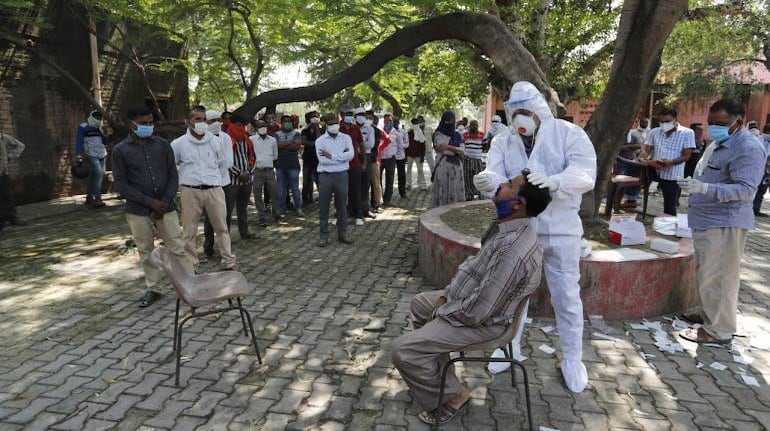
The number of daily new coronavirus cases in India has now fallen to half from the peak of almost a lakh in mid-September. India reported 53,370 new Covid-19 cases on October 24. The total Covid cases in India is around 7.81 million cases, of which 7.02 million people have recovered. There are about 1,18,000 deaths so far.
Maharashtra, the worst-hit state, recorded 6,417 cases on October 24, a decline of 66 percent from its peak in September.
The declining trend of Covid-19 cases in India could be possible due to higher testing and contact tracing, use of face masks and also possibly due to some level of herd immunity at play.
Jayaprakash Muliyil, a leading Indian epidemiologist attributes this to virus taking its own course.
The fodder that feeds the fire is susceptible people when that fuel is in shorter supply, the cases come down, Muliyil told Washington Post.
The marked decrease in Covid-19 cases is quite a contrast to the rising cases in Europe.
Also Read: These countries facing coronavirus second wave have gone back to lockdowns, curfews, restrictions
Why a coronavirus second wave in Europe? What went wrong?
According to the European Centre for Disease Prevention and Control (ECDPC), Europe has over Covid-19 200,000 cases, a dramatic rise considering cases in Europe had ebbed to below 15,000 in July.
The rise in cases in Europe is broad-based with not even Germany, which had a successful track record in containing the spread, spared this time. Countries are scrambling to contain the virus by announcing regional lockdowns, shutting of schools and colleges in affected areas.
ECDPC says although there has been a general increase in the levels of testing across all countries, which has resulted in the identification of additional cases who are asymptomatic or have experienced a mild form of the disease, this increase in testing does not explain the full epidemiological picture in these countries.
"In fact, the concurrent increase in test positivity observed in many countries, which for some has been accompanied by an increase in hospital and ICU admissions, indicates an escalating epidemiological situation.
Experts say there is some sort of complacency at play. Europe never really had a full-scale lockdown, as they feared the damaging consequences on their economies. Many opted for light restrictions. There was never a mandatory use of face masks, with exception of certain indoor places. There is also resistance at an individual level to wear masks, all this has enabled the second wave of Covid-19 pandemic.
Preventing coronavirus second wave in India - lessons from Europe
In India, the decrease in cases will relieve the pressure off on healthcare infrastructure to handle non-Covid cases.
The reduction in cases will also encourage the government to open up the economy at a much faster rate. India still places restrictions on opening up educational institutions, places of worship, theatres, among others.
There are lessons for India from Europe experience.
Any hastiness to return to normalcy poses the risk of the tide turning once again. Also, while the cases, on the whole, are falling, there are exceptions such as states like Kerala, Delhi and West Bengal that still have a rising number of cases.
Kerala had won praises for its handling of Covid-19 during the initial phases; the state's death rate though is still one of the lowest.
But it's also difficult to predict how sustainable this decline is. Experts warn Indian public and government shouldn't take the foot off the pedal and should continue to use face masks, practice social distancing and ensure personal hygiene.
The next two months would be crucial due to festival season, and especially the easing of lockdowns will expose the virus to people who have so far managed to escape.
Check Moneycontrol vaccine tracker for all the latest on Covid vaccine

Discover the latest Business News, Sensex, and Nifty updates. Obtain Personal Finance insights, tax queries, and expert opinions on Moneycontrol or download the Moneycontrol App to stay updated!
Find the best of Al News in one place, specially curated for you every weekend.
Stay on top of the latest tech trends and biggest startup news.