




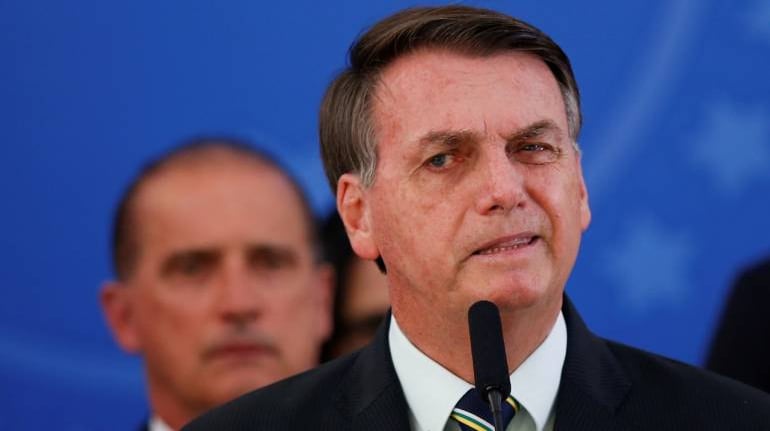
President Jair Bolsonaro of Brazil was struggling to govern effectively long before the explosive resignation speech of his star Cabinet minister, who basically called his soon-to-be former boss a criminal.
Bolsonaro became a president without a political party in November, after falling out with leaders of the Social Liberal Party, which had backed his presidential bid.
Several political allies — including two of Bolsonaro’s sons — are under investigation in a series of criminal and legislative inquiries. They include suspected money-laundering schemes and defamatory disinformation campaigns waged online.
In recent weeks, Bolsonaro’s strikingly dismissive response to the coronavirus pandemic, which he has called a “measly cold” that cannot be allowed to throttle economic growth, generated calls for impeachment at home and bewilderment abroad.
Given those challenges, which have left Bolsonaro deeply isolated, the dramatic exit of Justice Minister Sergio Moro on Friday was seen by critics and supporters of the president as a potentially destructive blow to his grip on power as his second year in office gets underway amid a public health crisis and a recession.
Known for his bombast and braggadocio, Bolsonaro may be gambling that lawmakers will not dare to impeach him and put Brazil, Latin America’s largest country, through another political spectacle like the one that felled a predecessor, Dilma Rousseff, four years ago.
It remains unclear what the recent developments will mean for his support base, which includes evangelical Christians and a stable of military leaders he appointed to top jobs.
Moro, a former federal judge who became the most iconic figure of an anti-corruption crusade that sparked hope across Latin America in recent years, resigned in protest after Bolsonaro fired the federal police chief, Maurício Valeixo.
In an extraordinary televised address delivered Friday morning from the Justice Ministry in Brasília, the capital, Moro said Bolsonaro intended to appoint a new police head that would do his political bidding by keeping him abreast of investigations and compiling intelligence dossiers at the president’s request.
Bolsonaro intends to appoint Alexandre Ramagem, the current head of Brazil’s intelligence agency, as the new police chief, according to reports in the Brazilian press. Ramagem was Bolsonaro’s head of security during his presidential campaign.
Moro’s accusation prompted Attorney General Augusto Aras to ask the Supreme Court to open a criminal investigation into the conduct Moro had described, saying that if confirmed, it amounted to obstruction of justice and other crimes.
“This all wears down the government at a time when all energies should be focused on fighting the virus and shoring up the economy, which is mired in crisis given the growing unemployment, misery and hunger,” Sen. Sergio Olimpio Gomes, who until recently had been among Bolsonaro’s top allies in Congress, said Friday night. “What happened yesterday constituted a perfect storm.”
As Brazil’s coronavirus contagion accelerated this past week, with nearly 53,000 confirmed cases and 3,670 deaths, speculation intensified over how much longer Bolsonaro would last in power as talk of impeachment and resignation ramped up.
“The president is digging his own grave,” former President Fernando Henrique Cardoso, who governed from 1995 to 2002, wrote in a message on Twitter. “May he quit before he’s removed. Spare us, on top of the coronavirus, from a long impeachment process.”
Gilmar Mendes, a Supreme Court justice, said Saturday that it was hard to predict just how damaging the investigations will be for Bolsonaro.
“Up until recently, I had the sense that the political class had no interest in talking about impeachment,” he said. “Now this is being discussed again with greater frequency.”
Bolsonaro appeared to grasp the political peril he faced when he delivered a long, defiant address Friday night in which he called Moro a liar and opportunist.
“The government endures,” Bolsonaro said toward the end, flanked by his remaining ministers.
The pandemic has upended the government’s economic policies, which sought to promote growth through austerity initiatives, privatizations and embracing free market reforms to attract foreign investment.
“That ultra free market talk has run head-on into the needs imposed by the pandemic,” said Laura Carvalho, an economist in São Paulo, noting that the government has been forced to violate its own spending caps and create new welfare programs.
Given how slowly and haltingly Brazil’s economy had been bouncing back from the recession that began in 2015, the long-term prospects are grim, she said. “There is no reason to expect the recovery will be swift,” she said.
The departure of Moro now confronts Bolsonaro with a powerful political rival who has long been assumed to harbor presidential ambitions of his own.
José Augusto Rosa, a congressional leader who heads a conservative pro-gun faction colloquially called the “bullet caucus,” called Moro’s departure a self-inflicted wound for a president struggling to manage the response to the pandemic and the resulting economic contraction, which economists predict will be about five percent this year.
“Moro was a pillar of stability in the government’s base, representing the fight against corruption and organized crime,” said Rosa, whose faction has broadly supported Bolsonaro. “This is a huge blow.”
A spokeswoman for Vem Pra Rua, an influential anti-corruption movement, said Moro’s resignation would erode Bolsonaro’s support base. The movement led massive demonstrations that helped to weaken the leftist party Bolsonaro defeated in his presidential bid.
“It was an ugly betrayal,” Adelaide de Oliveira, a spokeswoman for the group, said in reference to Bolsonaro’s alienation of Moro. “All Brazil poured out into the streets and we fought for many years to empower someone who genuinely wanted to do away with corruption in the country. Sadly, the dream ended today.”
While several Latin American leaders have seen a bounce in public opinion as they imposed strict quarantine measures to curb the spread of the coronavirus, Bolsonaro’s popularity has dropped amid what critics call a flailing response. The president’s opposition to social distancing measures led him to fire his popular health minister last week and pick fights with some of the country’s most powerful governors.
Acácio Machado, a 70-year-old retiree in Rio de Janeiro who voted for Bolsonaro in 2018, said he has come to regret his choice in recent months.
“I voted hoping there would be a change, but I was fooled,” he said, adding that many friends who voted for Bolsonaro had also come to rue their decision. “If I had had a crystal ball at the time, I would have spoiled my ballot.”
c.2020 The New York Times Company
Discover the latest Business News, Sensex, and Nifty updates. Obtain Personal Finance insights, tax queries, and expert opinions on Moneycontrol or download the Moneycontrol App to stay updated!
Find the best of Al News in one place, specially curated for you every weekend.
Stay on top of the latest tech trends and biggest startup news.