
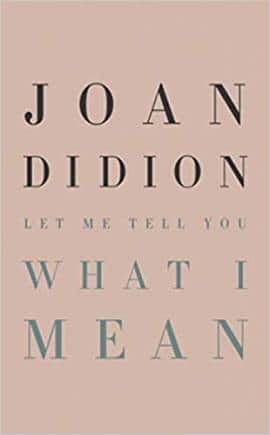
At the start of 2021, I learnt that Joan Didion's uncollected works, mostly journalistic pieces from the 1960s and '70s, would be published in a volume Let Me Tell You What I Mean. I was overjoyed, and pre-ordered the book.
When the book arrived, like always, I was enamoured by her prose—her reflective storytelling and eclectic sentences—and felt enriched reading each of its 12 essays.
 Joan Didion passed away months later, on December 23, 2021, at her home in Manhattan. She had been suffering from Parkinson’s disease for a long time. She was 87.
***
When the pandemic broke out and the world was locked down, days and nights appeared the same, as if time had stopped—a similar gloom that paralysed Didion when she lost her husband, also a writer and screenwriter, John Gregory Dunne, on December 30, 2003. In Didion’s well-crafted and fully formulated sentences, which explained every inexplicable thing to me, escape appeared easy.
Her sentences stood testament to the fact that this California-born writer never wrote anything without involving herself in the story. It was as if she were owning up: I am responsible for writing this. Like she was bearing witness, recording something. Thus, in more ways than one, her writerly ethos questioned the positionalities, of herself and that of her reader(s).
Her politics were far removed from the sometimes transactional nature of reporting. She observed silently, immersed herself in the environment, kept her ears to the ground, like a snake, which features often in her work.
A testament to this quality of hers is her writing, which spoke truth to power. Writing on varied subjects, including the American rock band The Doors, El Salvador, Central Park Five, she never failed to experiment with her prose. In almost all of her writing, she was telling us more about herself—and the world she inhabited—through her subjects.
Hilton Als, an American writer and critic, observes that it “was Didion’s fiction that taught her, I think, how to articulate what bugged her by tempering it with humour and a dry little sigh of exasperation.”
He also submits that her prose rendered this fact that “the truth is provisional, and the only thing backing it up is who you are at the time you wrote this or that, and that your joys and biases and prejudices are part of writing, too.”
“As a kid she was fed a steady diet of myths,” writes Als in his foreword to Let Me Tell You What I Mean, deconstructing for Didion’s audience who she was when she wasn’t Didion the Opiner, Didion the Master-Writer.
Eduene Jerrett, Didion’s mother, “was the more verbal of the two, and it was she who told Joan stories that fed her daughter’s imagination,” Als notes. And her father, Frank Didion, suffered from depression, which is why he was inaccessible—a feeling of loss, which even before losing her husband and her (adopted) daughter Quintana, would be apparent in any of Didion’s works if one were to read them closely enough.
Didion’s mother would give her daughter a “Big Tablet pad so she’d stop complaining and write down what was troubling her.” It was Eduene who encouraged teenage Didion to participate in a contest that would eventually fetch her a job at Vogue. Consequently, Didion moved to New York—a city that she had known the way Hollywood had presented it to her but it’d never be the same now that she was here, she says in a Netflix documentary The Center Will Not Hold, directed by her nephew Griffin Dunne.
The documentary, however, shows only a fraction of who Didion was and what she stood for. It provides some insights into the enigma she was—that she’d keep her manuscripts in a freezer when she felt a writer’s block or that she’d have chilled coke first thing in the morning. But it doesn’t do enough. Even if the character was Joan Didion, who was visible, in the documentary, she was absent.
For her presence, one must turn to her sentences—those aggressively worked out, chiselled to perfection, almost meditative and authoritative sentences—just like the way she considered the function of writing, as she noted in her essay whose title she borrowed from (George) Orwell: Why I Write.
First delivered as a talk, in this essay, Didion writes: “In many ways, writing is the act of saying I, of imposing oneself upon other people, of saying listen to me, see it my way, change your mind. It’s an aggressive, even a hostile act.”
It’s this engagement with language that rendered a personal tone and gravity to Didion’s words. This quality and her genius are perhaps best noticed in her memoirs The Year of Magical Thinking, in which she describes losing her husband, and Blue Nights—on the death of her daughter.
She wrote the former to “make sense of the period that followed” her husband’s death, wondering if she could have had a “digital editing system on which I could touch a key and collapse the sequence of time, show you simultaneously all the frames of memory that come to me now.”
I feel the same now. Silently cursing my incapability to weave words to express what she meant to me. All I can do is borrow her own words to make sense of her life (and death). From The Year of Magical Thinking:
Life changes fast.Life changes in the instant.You sit down to dinner and life as you know it ends.The question of self-pity.Discover the latest Business News, Sensex, and Nifty updates. Obtain Personal Finance insights, tax queries, and expert opinions on Moneycontrol or download the Moneycontrol App to stay updated!
Find the best of Al News in one place, specially curated for you every weekend.
Stay on top of the latest tech trends and biggest startup news.