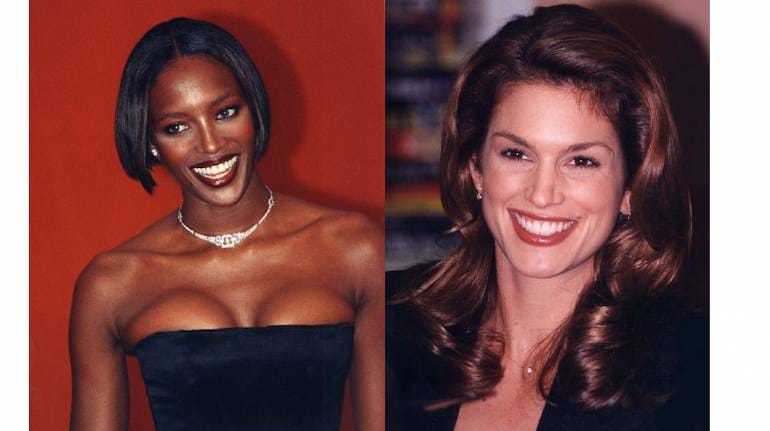
The supermodel as an influential pop culture figure of the 1990s was cast not on a runway, but in a music video. The story goes that the late English singer-songwriter George Michael, already a major star by the late 1980s, had tired of fame and the limelight. Publicly announcing that he “didn’t need the celebrity”, he decided to stay in the shadows, at home and in the studio, making his music and, for his 1990 album “Listen Without Prejudice Vol 1”, not feature in music videos.
For a natural showman, and more importantly a pop star, this retreat could have easily meant sudden death. But in stepped the then reigning queens of fashion, whom Michael spotted on an iconic cover of British Vogue. He was instantly enamoured. He rang up one Naomi Campbell and coaxed her, “leader of the group”, to convince the rest to do it.
Campbell and the rest of the group—Linda Evangelista, Cindy Crawford, (the late) Tatjana Patitz and Christy Turlington—worked with the acclaimed filmmaker David Fincher, who was then at the start of his career. And thus was born “Freedom! ’90”, an anthem, a statement, a perfect vision of the zeitgeist. And in that moment when pop culture and fashion crossed over, the supermodel was born.
Supermodels—those superhuman creatures blessed with #legsfordays, cheekbones that touch the sky, uncanny presence and worldwide recognition—were a phenomenon specific to the 1990s. The ‘Big Five’, as Evangelista, Campbell, Crawford, Patitz and Turlington (and later Kate Moss) were called, were its epitome.
Of course, they had risen individually in their careers, modelling and walking the ramp for haute couture brands all through the 1980s. But they were, for several reasons conjoined by a stroke of fate, the first of their kind to be recognized as more than just walking frames or mannequins on which legendary designers could hang their latest collections.
That aforementioned British Vogue cover was courtesy of Peter Lindbergh, a fashion photographer who broke from the traditions of his trade, choosing to shoot in a more realistic, naturalistic mould than the stifled, airbrushed imagery that was the hallmark before he arrived on the scene. That 1990 black-and-white image—reconstructed this year, minus Patitz—spoke to the collective power of the faces of fashion at a time when fashion itself was beginning to become part of the mainstream conversation.
Before the buzz of “Freedom! ’90” could die down, the Italian designer Gianni Versace cast the “supers” in his Fall 1991 show. For the finale, Campbell, Crawford, Turlington and Evangelista walked out, arms linked, lip syncing, once again to “Freedom! ’90”. The crossover—from print to MTV to the ramp—was complete. Fashion was now exciting to a much broader audience, and all the better for it.
The supermodels, meanwhile, were becoming celebrities in their own right. They turned entrepreneurs—from lingerie to modelling agencies to aerobics videos. They were showstoppers for the biggest names in fashion the world over—Armani, Calvin Klein, Ralph Lauren, Yves Saint Laurent—but it was their personal style that was perhaps more influential (and accessible) to young watchers.
They were pin-up girls, their lifestyle as aspirational as their physical attributes. Their faces and bodies were gold for the glossies, their private lives hot currency for the tabloids. They laughed, they partied, they flew around the globe—they lived the aspirational life—and they looked great doing it.
Models from India had walked international ramps since the 1970s. A recent Vogue India article tells the story of, for example, Kirat Young, who worked in the ateliers of Yves Saint Laurent and who taught Campbell how to walk; and of Marielou Phillips, who walked for and worked with Chanel for two decades. During the 1980s, Shyamolie Verma would come to be known as the “Lakme girl”. But the term ‘supermodel’ would enter day-to-day conversation only in the mid-1990s—and, arguably, it took another print-to-screen moment to make it happen.
Milind Soman and Madhu Sapre, nude but for sneakers, and a python wrapped around them—the unforgettable Tuffs ad was the end of innocence for much of India’s Gen X in 1995. Sapre had won the Femina Miss India pageant in 1992, and competed in the Miss Universe pageant—two years before Sushmita Sen would bring the crown home.
Soman had started his career in 1989 as a model for Thakersay Fabrics. In 1995, after slithering into the spotlight with the sneaker ad, he sprung out of a wooden box to sweep Alisha Chinai off her feet in the popular 1995 song “Made in India”. Soman’s place in fashion, pop culture and on the walls of many young Indians was cemented. But the Indian supermodel pecking order was just about being assembled in that decade, as Indian fashion began to become a thing and beauty pageants became the prism for finding India’s first top models.
Ujjwala Raut, Lakshmi Menon, Sheetal Mallar, Mehr Jesia, Noyonika Chatterjee, Marc Robinson—the Indian supermodel league bloomed during the mid-1990s to early-2000s period. Some of them would have very successful careers, many wouldn’t. Modelling was hardly a viable career—and very quickly would come to be seen as a stepping stone to the real thing.
By the late-2000s, the ‘supermodel’ had all but evaporated from the face of the earth. In fashion shows in India and elsewhere in the world, suddenly there was a flood of unrecognizable faces. There are several theories about what happened. For one, in the West, as grunge and heroin chic took over fashion trends, the ‘look’ turned to androgyny, dark circles under eyes, unsmiling faces—the anti-supermodel, if you will.
For another, in the new century, actors and musicians began to step into the places that the supermodels had carved out. Now, it was Demi Moore and Britney Spears on the covers of magazines and brand ambassadors for major labels. They had the cultural cache that the Big Five fleetingly held. And finally, there is the theory that there was an effort from within the industry to contain the power that supermodels had begun to exude.
Evangelista once infamously said in an interview: “We don’t get out of bed for less than $10,000.” And that one line has come to be regarded as symbolic of the problems that arose with supermodel culture, especially pertaining to attitude. While their diva-ness is retroactively being lauded, in India, supermodels were rapidly moving away from the ramp and in front of the screen. Bollywood was where money and fame lay, and everyone from Aishwarya Rai to Deepika Padukone, John Abraham to Arjun Rampal recognized it.
That is not to say Indian modelling is dead. Models like Nidhi Sunil and Avanthi Nagrath are making waves today. But their following is niche, including the hard fashion lover and industry insiders. The word ‘supermodel’ today might bring to mind Gigi Hadid or Kylie Jenner—but are they supermodels or social media influencers? Just like video killed the radio star, has Instagram and TikTok killed the supermodel?
Perhaps not. TikTok has certainly seen something of a renaissance where the Big Five are concerned. Vogue’s podcasts trace the history of the industry and the supermodels’ pivotal role in shaping them. Now, a highly anticipated Apple TV+ docu-series, releasing on September 20, will take us deeper into their lives and careers—those first five who started it all.
Which is all just proof that while we may never see a new supermodel emerge from the mass of human existence ever again, we remain attached to the aura, the symbolism, the essence of those that have gone before. At some level, that is the sound of gumption, of chutzpah to claim—like George Michael sang—“the way I play the game has got to change.”
Discover the latest Business News, Sensex, and Nifty updates. Obtain Personal Finance insights, tax queries, and expert opinions on Moneycontrol or download the Moneycontrol App to stay updated!
Find the best of Al News in one place, specially curated for you every weekend.
Stay on top of the latest tech trends and biggest startup news.