“Truth doesn’t come without the tax of effort,” Hercule Poirot, the eccentric detective at the heart of A Haunting in Venice declares to a partner. Nothing could be truer about a franchise that has taken two lukewarm films – one audaciously bad one – to get to a version that finds its stride. Branagh’s latest aspires to be a gothic mystery, punctuated by the usual Christiesms – a lot of suspicious people, with troubling backstories stuck in a place from where there is no apparent escape. What’s different this time around, however, is that the director-actor dispenses with the Christie model to conjure an air of grief and dread that though short on scares, is rife with tension, resentment and trauma. It’s still not exceptional, nor is it spooky but it does have the moody heft of an abrasive drama that just about manages to enthrall and enlighten.
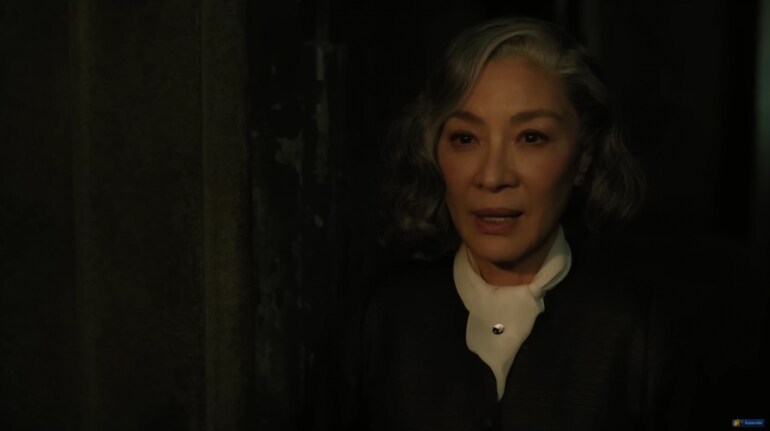
Set in post-war Venice, Branagh reprises his role as the Belgian sleuth Hercule Poirot. In retirement after the war, Poirot has stopped investigating cases. He is invited on a Halloween séance being conducted at a presumably haunted palazzo, by a former friend, the author Ariadne Oliver (Tina Fey). Also attending is a ‘medium’, Michelle Yeoh as the bewitching Mrs Reynolds. Reynolds is assisted by a young sibling couple on the run from the war. The palazzo, is rumoured to be roamed by the undead spirits of children who died here at the start of the infamous plague. It has most recently also witnessed, the death of a young girl, survived by the host, a grieving single mother. Also in attendance are the young girl’s former doctor (Jamie Dornan), his kid, her former lover, a housekeep, a commissioned bodyguard and so on. It’s a wide palette, as a Christie mystery so often is. Expectedly, chaos ensues after bodies fall and murder replaces the motif of afterlife, albeit with overlapping shades and shadows.
Loosely adapted from Christie’s Hallowe'en Party, Branagh’s film manufactures claustrophobia and myth out of Venice’s stuffy alleys and gravelly pavements. The cinematography commendably applies the spell of the territory to the visual palette and it injects this sense of unease into film’s tilted frames and candle-lit close-ups. The canals choke, the mice step out, as rainwater clogs a city built around the idea of floating. It’s enough that your brain doesn’t seek an empirical map of the city’s many entries and exits to interrogate the logistics of it all. Brannagh, for once, manages to coax the viewer to have a dialogue with the eeriness of a familiar premise, and commit to the soreness its material setting.
In A Haunting in Venice, Poirot is obviously up against the supernatural, and by extension the very thing he believes, or in this case, doesn’t. He has been invited to the séance to debunk a famed illusionist. But in a post-war Europe, there is perhaps no sight, no belief that reality can so casually condemn. For it is a constitution built on ruins, a world raised on the horrors of loss. Understandably, the doctor suffers from PTSD, children’s voices echo across the hollow corridors of the palazzo that signals as much grandeur as it is also shelters shattered hearts and minds. The shadow of the war looms large on this film, as Poirot, who has himself served in the war, must contemplate the idea that fact may not always be derived from rationale. It could also be a blurry mix of hope and denial, something as intangible as belief, or as condescending as the thing that Poirot himself cannot explain. Of course, he eventually will, but to what effect and at what cost?
Branagh’s slippery accent, his tedious direction – his Oscar-nominated Belfast being an exception - have all become forewarnings of anything he does, but here he ably fits an appealing ensemble inside a cramped mansion without having to surgically separate the mystery from its subjects’ sense of dispiritedness. In fact, the routine jump-scares only get in the way. A terrific cast could maybe have been offered more to do, but it at least holds up the wrenching despair, if not the thrilling whodunit that it is by design supposed to become. Like most Christie adaptations, the clues are obvious, the reveal a bit underwhelming. But what does stick is the film’s wounded sense of self that post-war men and women carry around as internal demons they must endlessly battle for their right to be called sane. In a world mapped by death, after all, ghosts would be the only faithful travellers.
After the horrifically bad Death on the Nile, Branagh’s conviction, his cheesy accent must have trembled at the idea of another outing as Poirot, the aggravatingly crummy detective whose put-on superficiality can easily get on your nerves. Here he even admits to being stifled by his own arrogance. And though that arrogance is punctured, and poked for weaknesses, for once the blazing return to form carries with it a sense of mortality. The attitudinal shift that greatness lies in doing good and not just grand. To solve not just cases but also pave the way for men and women of a traumatized world to heal. Even if it shakes your conscience, urges you to consider that which your learned self wouldn’t. A good mystery finds answers, a better one, asks questions.
Discover the latest Business News, Sensex, and Nifty updates. Obtain Personal Finance insights, tax queries, and expert opinions on Moneycontrol or download the Moneycontrol App to stay updated!
Find the best of Al News in one place, specially curated for you every weekend.
Stay on top of the latest tech trends and biggest startup news.