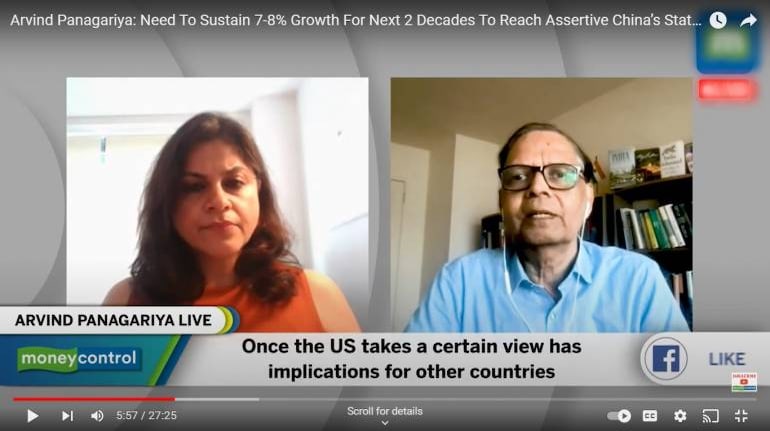
The American side rolled out a red-carpet welcome for Narendra Modi, with the Indian Prime Minister becoming only the third statesman to address a joint session of the US Congress for the second time, Arvind Panagariya, professor, Columbia University and former vice-chairman of NITI Aayog, tells Moneycontrol that in what would be his 50th year in the US in 2024, he hasn’t seen such a reception for any Indian Prime Minister and in fact that such a welcome has been given to very few world leaders.
“I have been here since 1974, this kind of buzz has never been there for any previous PM’s visit. Earlier visits by Indian PMs barely registered. All media in the US have covered the visit extensively,” said Panagariya.
The clear message to the world with this grand welcome is that there is a clear shift in geopolitical equations in the world, signifying India emerging as a key player and that its clout will continue to grow provided the country manages to grow at 7-8 per cent for the next two decades.
“Once the US takes a certain view it has implications for other countries… Remember what happened when Richard Nixon placed his bets on China and what followed. One of the key reasons why China rose geopolitically is because it also rose economically. India needs to grow economically,” Panagariya told Moneycontrol.
“We have an advantage but we need to sustain 7-8 percent growth for the next two decades for us to reach China’s status,” he added.
US President Richard Nixon had travelled to China in 1972, a time described as the “week that changed the world”. It ended a 22-year estrangement between the two countries.
Other governments around the world that had been toeing the US policy line of isolating and containing China opened up to the country, so in effect Nixon’s endorsement of China opened the world to China. Could the Joe Biden administration’s welcome compound the world’s interest in India? Panagariya believes so. But it will require effort from India to simplify rules of engagement and doing business in India, and. most importantly. grow.
“I have been in touch with investors who say that it is difficult to do business in India. Recent experience with Apple in Karnataka shows how our labour laws didn’t allow for 12-hour shifts, which was an issue. You cannot counter long-term hurdles with subsidies. We are banking too much on PLIs (production-linked incentive schemes). What after five years? You cannot substitute subsidies for good policies,” he lamented.
Discover the latest Business News, Sensex, and Nifty updates. Obtain Personal Finance insights, tax queries, and expert opinions on Moneycontrol or download the Moneycontrol App to stay updated!
Find the best of Al News in one place, specially curated for you every weekend.
Stay on top of the latest tech trends and biggest startup news.